


How to Get Rid of Wildfire Smoke Smell in the House Quickly and Safely
- May 22
- 10 min read
Most homeowners don't realize that the smell of wildfire smoke isn't really smoke anymore by the time you can still smell it. After the outdoor air clears, what stays behind is microscopic particulate and oily organic compounds that settled into your drywall, your carpet padding, your couch cushions, and the inside of your HVAC ductwork while the smoke was infiltrating. Every time the temperature shifts or your HVAC fan kicks on, those compounds release back into your air.
The good news is that you can clear this out. After working with thousands of customers through California, Oregon, and Colorado wildfire seasons, we've watched the same order of operations work in home after home, and it always starts with what your HVAC system is pulling through every fifteen minutes.
TL;DR Quick Answers
How To Get Rid Of Wildfire Smoke Smell In The House
Start by replacing your furnace filter with MERV 13 paired with an activated carbon stage, run your HVAC fan continuously for 24 to 48 hours, and pair that with a HEPA-and-carbon portable air purifier in your most-used rooms. Then wipe down hard surfaces, wash everything washable in hot water with vinegar or baking soda, and vacuum soft surfaces with a HEPA-equipped vacuum.
Top 5 Takeaways
The chemistry: Wildfire smoke smell is ultrafine particulate plus organic compounds bonded to walls, fabrics, and HVAC parts. They keep releasing odor for weeks.
Realistic timelines: Light exposure clears in one to four weeks. Heavy infiltration drags on for two to six months without active cleanup.
Minimum filtration: MERV 13 is the residential baseline. Pair it with activated carbon if you actually want to capture the gas-phase compounds driving the smell.
Different surfaces, different methods: Walls, fabrics, carpets, and ductwork each need a different treatment. One product cannot do all four.
What not to do: Skip the ozone generator. The EPA does not recommend ozone for occupied homes because it irritates the lungs and creates additional pollutants.
Why does Wildfire Smoke Smell Stick Around
Two things ride into your house with wildfire smoke at the same time. There's the fine particulate, PM2.5, nd the ultrafine particles smaller than that, and there's a chemical cocktail of volatile organic compounds and polycyclic aromatic hydrocarbons. The particulate settles fast and acts as a delivery vehicle for the VOCs, which then bond to every porous surface they can find — drywall paper, untreated wood, upholstery foam, carpet padding, the inside of your ductwork.
After the outdoor air clears, those surfaces keep releasing what they absorbed for weeks. That's why the smell often spikes when your AC or heat first kicks on in the morning. The temperature change wakes the chemistry back up.

How To Clean Wildfire Smoke Smell Out Of Your House Step By Step
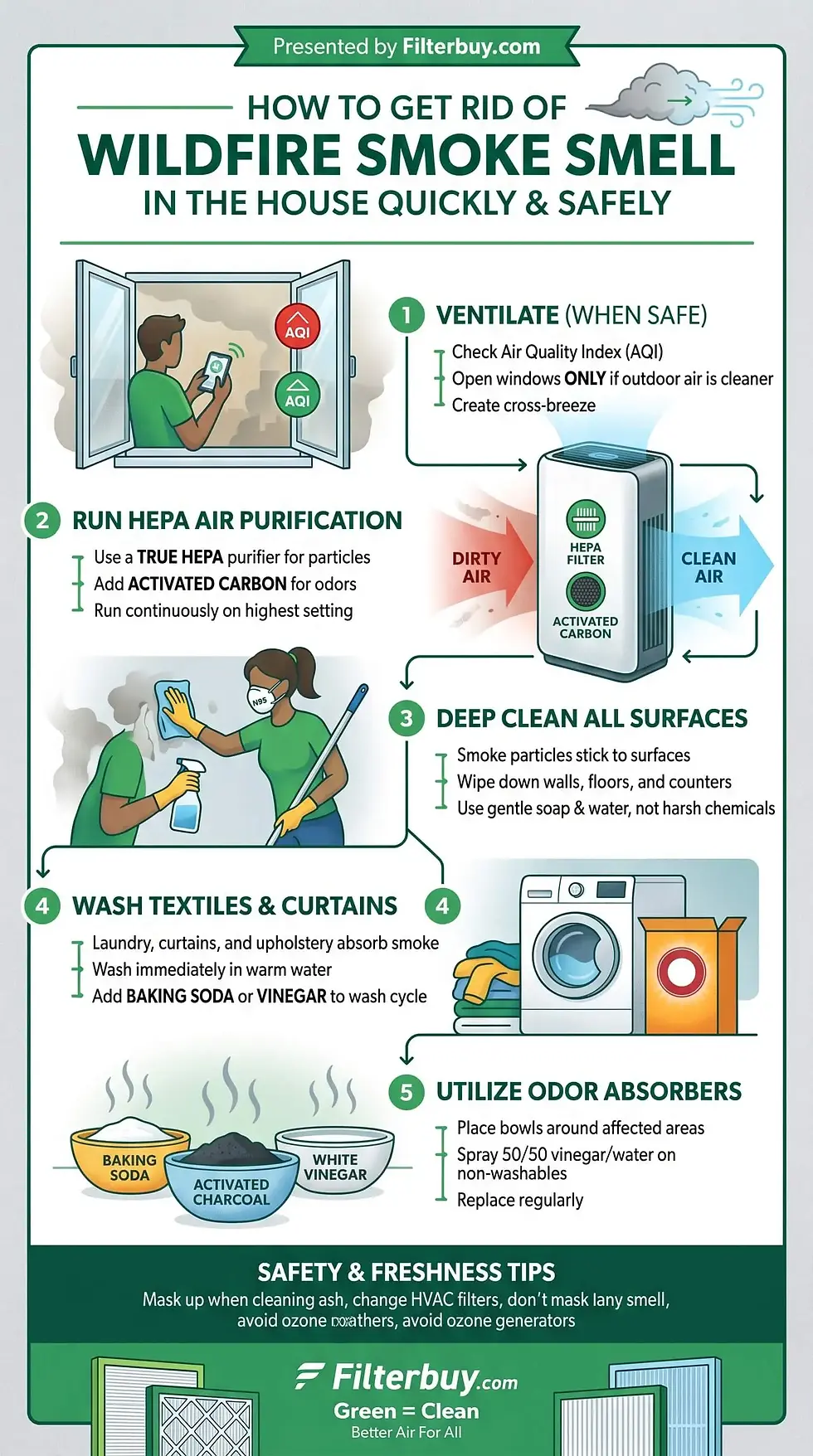
Order matters more than products. Start with the air, move to hard surfaces once you have filtration running, and save the fabrics for last so you aren't re-contaminating freshly cleaned material with what you stir up. Run a portable air purifier in whichever room you are working in. Keep windows closed until the outdoor AQI reads under 50.
Hard Surfaces And Walls
Wipe down ceilings, walls, doors, trim, light fixtures, and rigid furniture with a degreasing solution. A trisodium phosphate substitute or a 1-to-10 white vinegar dilution works on most painted surfaces. Test in an inconspicuous spot first. Smoke residue is oily, so a dry duster will only spread it. Use clean microfiber cloths and change them out often as they load up.
Carpet, Rugs, And Upholstered Furniture
Vacuum slowly with a HEPA-equipped vacuum, then sprinkle baking soda generously, let it sit overnight, and vacuum again. For deep contamination, professional hot-water extraction or steam cleaning with a deodorizing agent is the next step. Furniture you cannot fully clean may need replacement, especially foam cushions that absorbed smoke at the molecular level.
Clothes, Bedding, And Curtains
Wash everything washable in the hottest water the fabric allows. Add a half cup of white vinegar or a half cup of baking soda to the wash cycle. Skip fabric softener until the smell is fully gone. Heavy items like comforters and blackout curtains often need two or three cycles. Dry-clean-only garments should go to a cleaner you tell upfront that the items were smoke-exposed.
The HVAC System
Replace your furnace filter immediately. Move from a basic MERV 8 to MERV 13 with an activated carbon stage to handle the gas-phase compounds that the particulate side of the filter cannot capture on its own. Our deeper dive on the best MERV filter for wildfire smoke walks through the comparison if you want to see why MERV 13 with carbon outperforms a MERV 16 without it for smoke specifically. Wipe down accessible return grilles and supply registers. Run the system fan continuously for 24 to 48 hours to flush the air. If the ductwork was heavily exposed, a professional duct cleaning is worth pricing out, especially if you still smell smoke at the supply vents after a fresh filter is installed.
What Neutralizes And Absorbs Wildfire Smoke Smell
Two categories of products actually do the work. Adsorbents pull the molecules out of the air, and neutralizers chemically react with them. Both belong in your plan.
Activated carbon is the workhorse for gas-phase wildfire compounds. It captures VOCs and PAHs through its enormous internal surface area, and the heavier the carbon weight in a filter, the longer it lasts before saturation. Baking soda absorbs odors from soft surfaces over hours, not minutes. White vinegar bowls placed in affected rooms help on the margin.
Enzymatic cleaners break down organic residue and work especially well on fabrics.
Air fresheners and scented sprays mask the smell. They do not neutralize anything. They can also react with smoke compounds in ways that worsen indoor air, so skip them until the underlying problem is fully resolved.
The Right Air Filter And Air Purifier For Wildfire Smoke
The HVAC filter we recommend for any smoke event is MERV 13 paired with an activated carbon stage. MERV 13 captures the fine particulate that carries most of the smell. The carbon stage handles the gas-phase compounds the particulate side cannot stop on its own. Confirm your air handler can pull air through a MERV 13 before installing one, especially on older systems where airflow is already tight.
For portable air purifiers, a true HEPA filter combined with several pounds of activated carbon is the right setup. Match the unit's Clean Air Delivery Rate to your room volume. A purifier rated for a 200 square foot bedroom will not clean a 600 square foot living room.
When portable purifier capacity is short, the EPA-recommended DIY box fan with a MERV 13 filter strapped to the intake works as emergency capacity. It costs a fraction of a commercial purifier, and the EPA has documented its effectiveness in heavy smoke conditions.
When Wildfire Smoke Smell In House Won't Go Away
If the smell persists after you have run air cleaning, replaced filters, washed every fabric, and wiped every surface, the contamination has likely penetrated materials you cannot easily access. Drywall paper, attic insulation, wall cavities, and the interior of HVAC ductwork are the usual suspects.
That is when a professional smoke remediation contractor is the right call. Ask whether they use hydroxyl generators (safer than ozone), thermal fogging, and HEPA-filtered negative air machines. Get the scope of work in writing and request before-and-after air quality testing if the exposure was severe or prolonged.
“After manufacturing filters for over a decade and serving more than two million households, we have noticed that the homes recovering fastest from wildfire smoke events all start with the HVAC system. They install a MERV 13 filter with activated carbon on day one and let the system fan run nonstop until the smell is gone.”
Essential Resources On How To Get Rid Of Wildfire Smoke Smell in the House
Once you have a plan in place on how to get rid of wildfire smoke in the house, these are the seven sources we point customers to first when they want federal guidance, real-time monitoring, engineering standards, and respiratory health context for a smoke event.
Start Here For Federal Smoke Exposure Guidance
The U.S. Environmental Protection Agency lays out how wildfire smoke moves indoors, who is most at risk, and which filtration upgrades reduce exposure during a smoke event.
Get The Public Health Playbook For Smoke Events
The Centers for Disease Control and Prevention covers indoor air strategies, when to seek medical care, and how to protect children, older adults, and people living with asthma during wildfire smoke episodes.
Track The Air You Are Cleaning Up Around
AirNow's wildfire health resources include daily AQI readings and practical guidance for keeping your household healthy when smoke moves into your area.
Source: AirNow Fires And Your Health
Understand Why Asthma And Allergies Flare After A Fire
The Asthma and Allergy Foundation of America explains how airborne particulate matter from smoke triggers respiratory symptoms and which indoor controls deliver the largest improvements for sensitive household members.
Source: AAFA Air Pollution And Asthma
See What Engineers Recommend For Filtration
ASHRAE's published position on filtration and air cleaning details the MERV ratings, activated carbon use cases, and ventilation rates indoor environments need to manage smoke and fine particulate.
Read The State-Level Response From California
The California Air Resources Board's Smoke Ready California program lays out filter recommendations, certified air cleaner guidance, and indoor sheltering steps for households in heavy-smoke regions.
Source: CARB Smoke Ready California
Connect Smoke Exposure To Long-Term Lung Health
The American Lung Association documents the respiratory risks of wildfire smoke, including who is most vulnerable and which preventive steps reduce emergency department visits during peak fire days.
Supporting Statistics
These three data points shape how we think about the cleanup window after a wildfire smoke event. Each comes from a separate primary source, so you can verify the claim independently.
At What MERV Rating Do Mold Spores Start to Be Filtered Reliably by Air Filters?
A 2021 study in Nature Communications found that a 10 microgram per cubic meter increase in wildfire-specific PM2.5 raised respiratory hospitalizations by 1.3% to 10%, compared to 0.67% to 1.3% for non-wildfire PM2.5 of the same concentration. The AQI number alone understates the indoor cleanup work after a wildfire.
Smoke from Western Fires Routinely Crosses the Entire Continent
The U.S. Forest Service has documented wildfire smoke plumes from large western U.S. fires being transported across North America, with PM2.5 concentrations reaching unhealthy to hazardous levels on the EPA Air Quality Index in regions thousands of miles from the fire source.
Wildfire Activity Continues to Run Above the Ten-Year Average
The National Interagency Fire Center recorded 64,897 wildfires that burned 8,924,884 acres in 2024, exceeding both the five-year and ten-year averages. The annual smoke load that follows is why indoor cleanup planning is no longer a one-off concern.
Final Thoughts And Opinion
After watching customers work through wildfire seasons in California, Oregon, Colorado, and Arizona, we keep coming back to one piece of advice. The order you clean matters more than the products you pick up at the hardware store. Most failed cleanups we hear about start with steam cleaning the carpet on day one while the HVAC system is still circulating smoke-laden air every fifteen minutes. The smell comes back inside 48 hours.
The sequence that holds up moves air first, then hard surfaces, then soft furnishings, then one more air-cleaning pass to catch what got stirred up during the wipe-down. A MERV 13 filter paired with activated carbon is the single highest-impact upgrade in that whole sequence. It works 24 hours a day, not just during one cleaning session. Think of your HVAC as the lungs of your house. If it stays contaminated, nothing else stays clean for long.
Frequently Asked Questions
Q: Does wildfire smoke smell go away on its own?
A: Yes, but slowly and incompletely. Light exposure airs out in one to four weeks if you keep windows open during clean-air hours and run filtration. Heavy exposure can linger six months or longer without active cleanup of surfaces, fabrics, and HVAC.
Q: How long does wildfire smoke smell last in a house?
A: Light smoke exposure usually clears in one to four weeks. Heavy infiltration can take two to six months. The exact timeline depends on how many porous materials are present, how contaminated the HVAC system became, and how quickly you start active cleaning.
Q: What if the wildfire smoke smell in my house won't go away?
A: Persistent smell signals deep contamination of drywall, insulation, ductwork, or upholstery foam. Replace your HVAC filter, run a HEPA purifier with activated carbon continuously, and call a smoke remediation contractor if the smell remains after two to three weeks of consistent cleanup.
Q: How do I get the wildfire smoke smell out of my HVAC system?
A: Replace your filter with MERV 13 paired with activated carbon, then wipe down the return and supply grilles. Run the system fan continuously for 24 to 48 hours to flush the air. If you still smell smoke at the supply vents after a fresh filter is installed, price out a professional duct cleaning.
Q: Will a HEPA filter remove the smell of wildfire smoke?
A: A HEPA filter captures the fine particles that carry most smoke compounds, which reduces the smell significantly. To neutralize the gas-phase odor on top of that, pair the HEPA stage with an activated carbon stage in the same purifier.
Q: Is MERV 13 enough for wildfire smoke?
A: Yes, MERV 13 is the realistic baseline for residential HVAC during smoke events. It captures the PM2.5 particulate that carries most of the smoke compounds. Combining it with an activated carbon stage addresses the VOCs that drive the lingering smell.
Q: How do I remove wildfire smoke smell from clothes and bedding?
A: Wash in the hottest water the fabric allows, adding half a cup of white vinegar or baking soda to the cycle. Skip fabric softener until the smell is gone. Heavy items like comforters or curtains may need two or three washes to clear fully.
Q: Should I use an ozone generator to remove the smell of smoke?
A: No, not in occupied spaces. The EPA does not recommend ozone generators for indoor odor control because ozone irritates lungs and reacts with indoor materials to create additional pollutants. Hydroxyl generators are a safer professional alternative when heavy remediation is needed.
Q: What absorbs the smell of wildfire smoke from carpet and furniture?
A: Baking soda absorbs odors when sprinkled on overnight and vacuumed up the next morning. Activated carbon pouches placed near affected furniture help in the long term. For deep contamination, professional hot-water extraction with a deodorizing agent is the next step.
Q: When should I hire a professional smoke remediation company?
A: Call a professional if the smell persists after two to three weeks of active cleanup, if the home took heavy or prolonged smoke exposure, or if you have residents with asthma or compromised lungs. Ask for HEPA-filtered negative air machines and a written scope of work before signing.
Find The Right Filter For Wildfire Smoke Cleanup
You're the one looking out for your household's air, and the fastest way to start clearing the wildfire smoke smell out of your home is upgrading your HVAC filter to MERV 13 with an activated carbon stage. Shop MERV 13 wildfire smoke filters to find the size that fits your system, then start running it tonight.


Comments