


MERV 13 Vs HEPA — What HVAC Professionals Recommend For Homes With Pets
At the end of summer, run a hand along your supply register and check the residue. You'll find dander, pollen, and what looks like fifteen pounds of golden retriever undercoat. That's the load your HVAC filter handles every time the blower kicks on, and it's why the MERV 13 vs HEPA debate keeps coming up in homes with pets. The wrong filter choice doesn't just dirty the air. It can starve the blower, freeze the cooling coils, and shorten the life of a system you paid five figures for. Get the right one, and you protect your air quality, your family, and your HVAC equipment all at once.
TL;DR Quick Answers
MERV 13 Vs HEPA
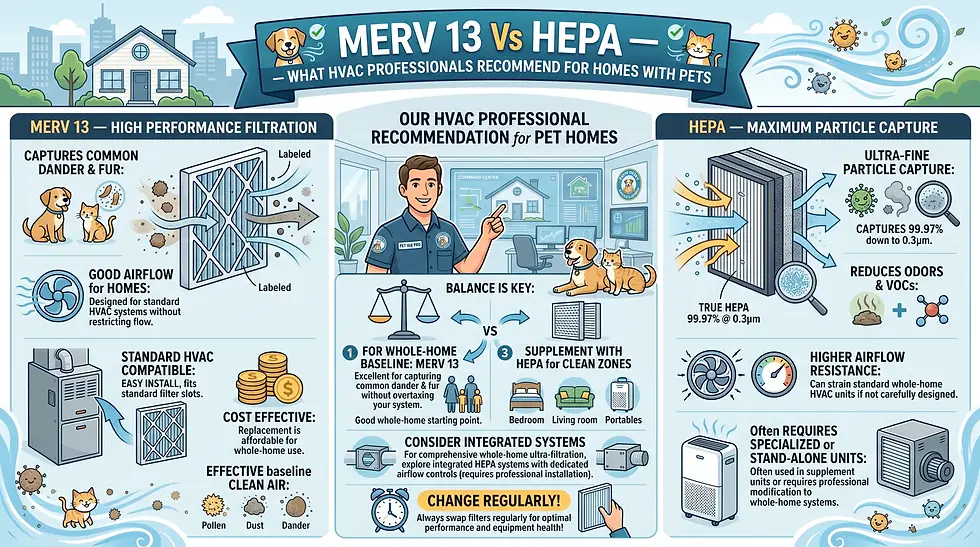
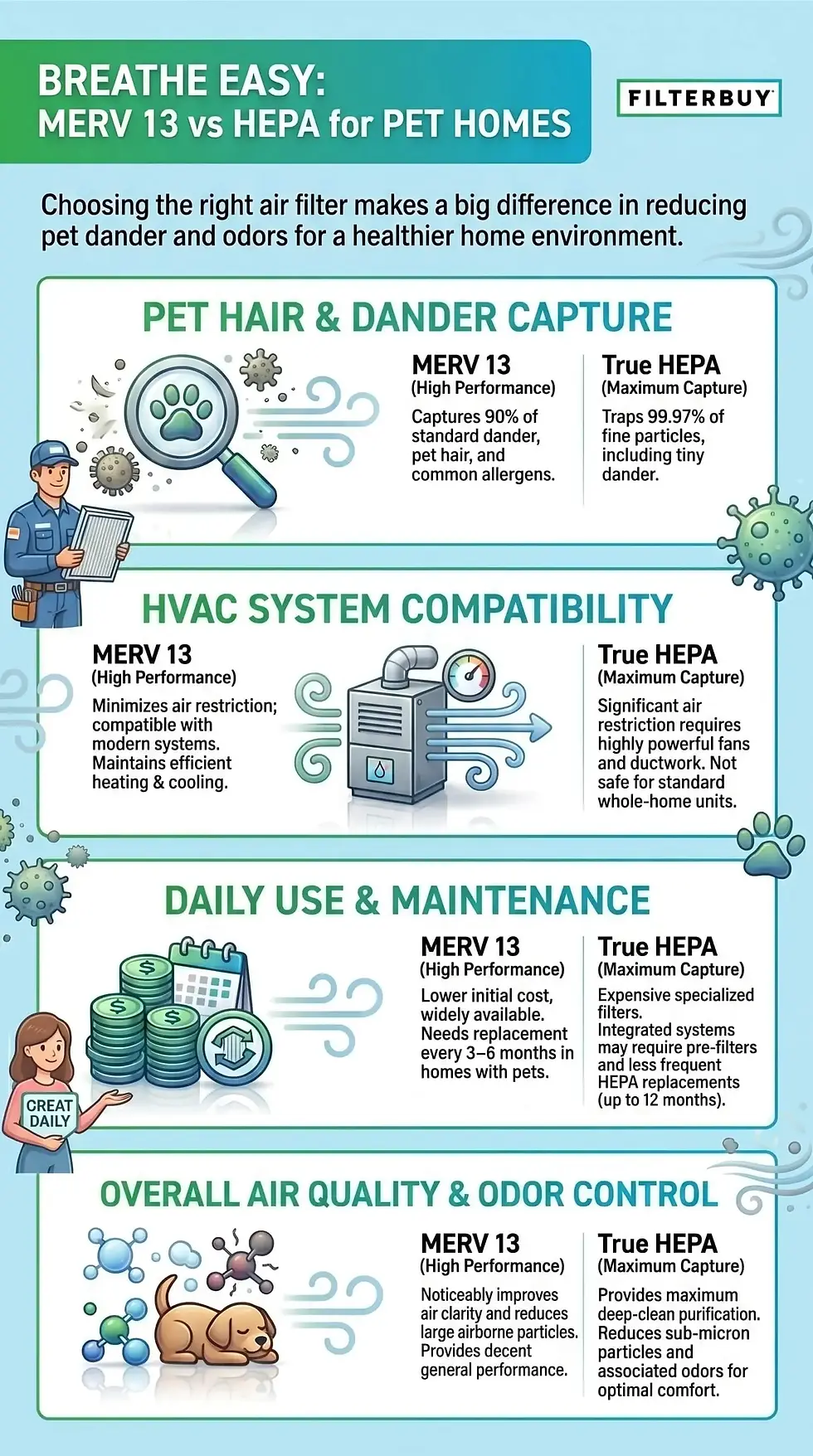
In a pet home with a standard central HVAC, MERV 13 is the right whole-home filter, and True HEPA is not a safe drop-in. MERV 13 captures 50 percent or more of 0.3-micron particles and 90 percent or more of pet dander, pollen, and mold spores. True HEPA captures 99.97 percent at 0.3 microns, but the media is too dense for most residential furnaces and air handlers to push air through without damage. We recommend running MERV 13 in the central return and adding a portable HEPA room cleaner in the bedroom of anyone with a diagnosed pet allergy.
Top 5 Takeaways
EPA recommends MERV 13 as the residential minimum for any household worried about small particles, viruses, or allergens.
True HEPA filters don't fit standard residential HVAC. The media is too dense, and forcing it into the wrong slot strains the blower and chokes airflow.
MERV 13 captures virtually every pet hair, the majority of pet dander, and most of the allergen-carrying particles. MERV 13 doesn't fully handle the sub-micron fraction, and that's exactly what a portable HEPA room cleaner is built for.
Pet households should change a 1-inch MERV 13 air filter every 30 to 60 days. Thicker 4-inch and 5-inch media filters stretch that schedule to 6 or 9 months under the same conditions.
For most pet-owning families, we recommend MERV 13 in the central return plus a portable HEPA in the bedroom of anyone with a diagnosed allergy.
How MERV Ratings And The HEPA Standard Actually Differ
MERV stands for Minimum Efficiency Reporting Value. ASHRAE developed the scale in 1987 to measure how well a filter captures particles between 0.3 and 10 microns, and it runs from MERV 1 to MERV 16 for residential and commercial applications. Each rating report captures efficiency across three particle-size bands.
A MERV 8 filter catches roughly 70 to 85 percent of 3- to 10-micron particles. MERV 11 pushes that to 85 percent or higher. MERV 13 catches 90 percent or higher of 3- to 10-micron particles, 85 percent or higher at 1 to 3 microns, and about 50 percent at 0.3 to 1 micron. That's the capture profile that made MERV 13 the residential default for households that take indoor air quality seriously.
True HEPA runs on a different testing standard altogether. The U.S. Department of Energy defines a True HEPA filter as one that captures 99.97 percent of particles at 0.3 microns, the most penetrating particle size. HEPA catches particles larger or smaller than 0.3 microns at even higher efficiency. Manufacturers also test HEPA media for leakage to confirm no particle-laden air slips past the frame seal.
The two ratings aren't interchangeable. HEPA performance corresponds to MERV 17 through 20, which sits above the standard residential MERV scale. That's why a MERV 16 filter, even at the top of the residential chart, still doesn't meet the True HEPA threshold.
Why Most Residential HVAC Systems Cannot Run A True HEPA Filter
True HEPA media is dense by design. The same fiber matrix that captures 99.97 percent of 0.3-micron particles also creates serious resistance to airflow — what HVAC engineers call static pressure drop. Standard residential furnace blowers are sized for filters in the MERV 8 to MERV 13 range. The manufacturer designed the compressor and motor around that pressure drop, not a tighter one.
Drop a True HEPA filter into a return slot built for MERV 11, and the system has to work harder to move the same volume of air. The blower motor runs hotter, coils ice up in cooling mode, and the furnace short-cycles in heating mode. Air handlers eventually fail prematurely. Less conditioned air reaches the rooms that need it, and the energy bill climbs to chase the deficit.
Whole-home HEPA systems do exist. They take the form of a HEPA bypass unit, which is a dedicated cabinet installed in parallel to the main return, so only a portion of the airflow passes through the HEPA media. Setups like these need professional sizing, ductwork modifications, and careful balancing. They make sense for households with a specific medical need that justifies the investment. For most pet-owning families, the simpler and more reliable move is to run MERV 13 in the central system and place portable HEPA cleaners in the rooms where they actually help.
What MERV 13 Catches In A Pet Household
Pet hair is large by air-quality standards. A single strand of dog or cat hair measures roughly 20 to 100 microns across, which means even a MERV 8 filter catches it without much effort. The harder filtration problem in a pet household is dander, the microscopic flakes of dead skin that pets shed continuously.
Dog dander particles run roughly 2.5 to 10 microns across. Cat dander runs even smaller, with some particles falling between 1 and 20 microns. The Fel d 1 protein, which is what most cat-allergic people react to, frequently attaches to particles under 5 microns. That's small enough to stay airborne for hours and travel through the home on normal HVAC airflow instead of settling onto the carpet where you can vacuum it up.
This is where MERV 13 earns its reputation as the pet-household upgrade. At 1 to 3 microns, MERV 13 captures 85 percent or more of what passes through. At 3 to 10 microns, the capture rate climbs above 90 percent. That covers virtually every pet hair and the majority of dander circulating through the duct system.
What MERV 13 doesn't fully handle is the sub-micron slice. For those particles, a portable HEPA room cleaner in the bedroom of anyone with a diagnosed pet allergy fills the gap. MERV 13 in the central return plus HEPA in the bedroom is the combination we keep coming back to. It delivers the cleanest air at the lowest cost without putting the HVAC system at risk.
“After manufacturing filters for over a decade and serving more than two million households, the pattern we see in pet homes is consistent. MERV 13 in the central HVAC handles 90 percent or more of the dander and allergen load, and a portable HEPA room cleaner takes care of the bedrooms where allergy sufferers actually sleep.”
Essential Resources On MERV 13 Vs HEPA
If you want to verify any of the claims on this page, here are seven sources we trust. Each comes from a federal agency or non-profit that sets the standards or funds the research. Every link points to a specific article rather than a homepage.
1. Get The Federal Definition Of A HEPA Filter Straight From The EPA
The EPA's HEPA explainer is the federal baseline for what a True HEPA filter is and what it isn't. The page covers the 99.97 percent capture threshold at 0.3 microns, why that particle size matters more than smaller or larger ones, and how HEPA differs from the MERV scale. Start here if you read one source on this topic.
Source: EPA HEPA filter definition
2. Read The Industry Position On Residential Filtration From ASHRAE
ASHRAE wrote the MERV testing standard, and its formal position document on filtration and air cleaning is the engineering reference behind every credible MERV recommendation in the country. The document explains what filtration can and can't accomplish for indoor air quality, and it makes the case for MERV 13 as the post-COVID residential baseline. Pull it when you want the technical detail behind any recommendation on this page.
3. Learn How To Reduce Pet Dander At Home From The AAFA
Filtration is one piece of the indoor-allergen puzzle. The Asthma and Allergy Foundation of America's guide to controlling indoor allergens covers the rest, from washing pet bedding weekly to vacuuming with a HEPA-equipped machine and limiting where pets sleep. Pair your MERV 13 setup with these steps, and the results compound.
4. Understand How Pet Dander Affects Indoor Air With The American Lung Association
The American Lung Association's pet dander resource explains exactly which allergens cats and dogs produce and how those allergens move through indoor air. It's worth reading if someone in your home has a diagnosed pet allergy and you want a health-focused take rather than an HVAC-focused one.
5. Get The Medical Expert View Of Pet Allergy From The AAAAI
The American Academy of Allergy, Asthma & Immunology trains and certifies allergists across the United States, and its pet allergy guide reflects what those specialists tell patients in the exam room. The page covers symptoms, diagnosis, treatment, and management. It's the right reference when someone in your home is showing allergy symptoms,s and you want a clinical view before adjusting your filtration setup.
6. Apply CDC Guidance On Indoor Air And Ventilation
The CDC's NIOSH ventilation guidance covers air cleanliness, filtration, and source control in residential and workplace settings. The agency endorses upgrading central HVAC filter efficiency to MERV 13 or higher wherever the system can accommodate it.
7. Compare HEPA Standards Set By The Department Of Energy
The U.S. Department of Energy is the federal agency that defines what qualifies as a True HEPA filter. The DOE Filter Test Facility page is the original technical reference for the 99.97 percent capture standard and the testing methodology behind it. Cross-check HEPA marketing claims against it when something sounds too good.
Supporting Statistics On Pet Households And Air Filtration
These three numbers come from independent national sources we didn't already cite above. Each one frames the scale of the pet-household filtration question, and every link goes to an article rather than a homepage.
1. Ninety-Five Million U.S. Households Own A Pet
About 95 million U.S. households own at least one pet, according to the 2025 National Pet Owners Survey cited in the 2026 State of the Industry Report. That's not a niche question. The MERV 13 vs HEPA decision is one of the most common filter decisions in the country right now.
2. Nearly 10 Million Americans Are Allergic To Their Pets
Almost 10 million pet owners in the United States, including children, are allergic to their animals, according to the American College of Allergy, Asthma, and Immunology. In those households, filtration crosses over from a cosmetic upgrade into a health intervention.
3. Approximately 45% Of U.S. Households Own A Dog
About 45 percent of U.S. households own at least one dog, and 29 percent own at least one cat, per the American Veterinary Medical Association. Multi-pet households are common, and a dog-plus-cat home generates a combined dander load that MERV 13 was designed to handle without overburdening the HVAC system.
Final Thoughts And Opinion
For nearly every pet-owning household with a standard central HVAC system, MERV 13 is the right answer. HEPA is the household name people associate with the cleanest air possible, and that brand recognition is why the question keeps coming up. The recognition doesn't translate to system compatibility, though. A True HEPA filter forced into a residential return slot chokes airflow and stops the HVAC system from doing its actual job, which leaves the air worse off than it would have been with a properly-rated filter.
Here's what we recommend for pet families:
MERV 13 in the central return for whole-home protection.
Replacement every 30 to 60 days for 1-inch filters, or every 6 to 9 months for 4-inch and 5-inch media filters.
A portable HEPA room cleaner in any bedroom where someone has a diagnosed pet allergy.
A HEPA-equipped vacuum is used twice weekly on carpeted areas where pets sleep.
That four-part setup costs less than a single failed HVAC service call, fits any standard residential system, and delivers the cleanest air the equipment was engineered to deliver. The marketing pitch for True HEPA in a residential return is louder than the engineering case behind it. We side with the engineering.
Frequently Asked Questions
Q: Does a MERV 13 Filter Viruses?
A: Yes, MERV 13 catches a meaningful portion of the respiratory droplets that carry viruses, which is why the CDC and ASHRAE both adopted MERV 13 as the recommended residential minimum after COVID-19. No filter is a virus-proof barrier. MERV 13 works as one layer alongside normal ventilation and source control, and it's the strongest viral-reduction performance a standard residential HVAC system can deliver without modification.
Q: Is MERV 13 Good Enough For Allergies?
A: For most allergy sufferers, MERV 13 is enough as the whole-home filter. It catches 90 percent or more of the larger allergen particles (pollen, dust mites, pet dander) and 50 percent or more of the sub-micron particles that include some bacteria. If someone in your home has a severe or medically diagnosed allergy, add a portable HEPA room cleaner in that person's bedroom on top of the whole-home MERV 13.
Q: Can I Use A HEPA Filter In My Furnace?
A: No, not in a standard residential furnace. True HEPA media is too dense for the typical residential blower. The pressure drop strains the motor, reduces airflow to the rooms, and can shorten equipment life. Whole-home HEPA systems do exist as a separate bypass unit, but they take professional engineering and ductwork changes that rarely pencil out for a typical residence.
Q: Is MERV 16 Equivalent To HEPA?
A: No. MERV 16 sits at the top of the standard MERV scale and captures 95 percent or more of 0.3- to 1-micron particles, which is excellent residential performance. True HEPA performance starts at MERV 17 and runs up through MERV 20, all of which sit above the standard residential chart. HEPA's 99.97 percent capture threshold at 0.3 microns is stricter than what any standard residential MERV filter is built to deliver.
Q: How Often Should I Change A MERV 13 Filter In A Pet Household?
A: For 1-inch MERV 13 filters in a home with one or more shedding pets, every 30 to 60 days is the right cadence. The thicker 4-inch and 5-inch media filters stretch to 6 or 9 months under the same conditions, because more pleated surface area means more dirt-holding capacity. Regardless of which thickness you use, pull the filter every 30 days and look at it. If it's gray or matted, change it.
Q: Will an MERV 13 Filter Damage My HVAC System?
A: For most modern residential HVAC systems, no. The EPA confirms that most furnaces and central air systems can accommodate MERV 13 without equipment problems, as long as the filter gets replaced on schedule. If your system is older than 20 years, or your blower is unusually low-static, have an HVAC professional take a look before you step up from MERV 8 or 11 to MERV 13.
Shop MERV 13 Filters Built For Pet-Owning Homes
Filterbuy manufactures MERV 13 filters in more than 600 standard sizes plus custom dimensions, all built in our U.S. facilities and shipped factory-direct to your door. Find the right MERV 13 for your system today and give your pet-owning home the whole-home filtration upgrade your HVAC system was designed to handle.


Comments