


What Does Activated Carbon in Air Filters Do That Makes It Different from Standard Pleated Filters: A Homeowner’s Guide
Your MERV 8 catches dust, pollen, and the larger junk your HVAC pulls in through the return. It does not catch what you smell. That is the gap that activated carbon fills.
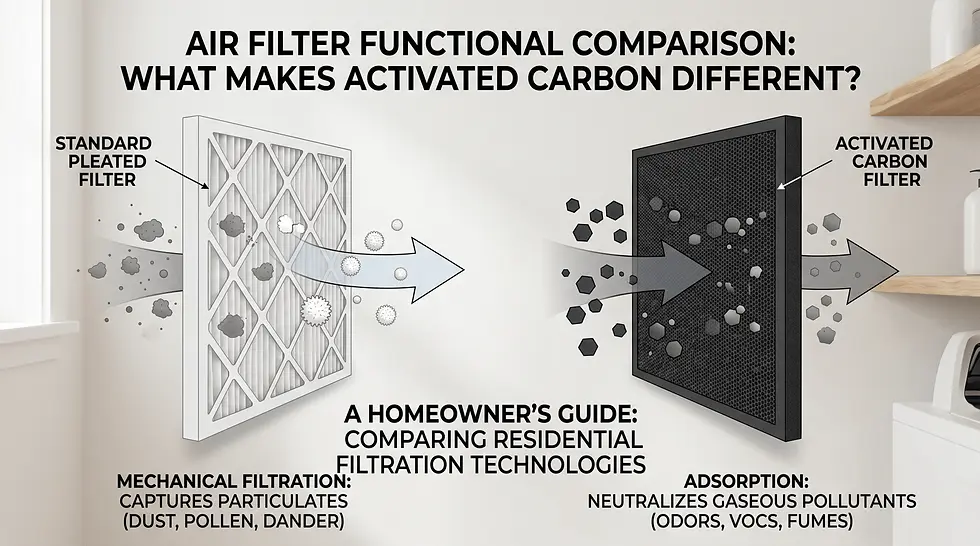
Carbon traps gas-phase pollutants, including odors, smoke, and volatile organic compounds, through a process called adsorption. Individual molecules cling to the carbon’s huge internal pore network as air moves across it. The pleated media handles particles. Adding a carbon layer to that same pleat catches what you taste and feel in the air after the particles are gone.
We have been making carbon-bonded pleated media for residential HVAC systems for years at Filterbuy, and what we have learned about when carbon pays off, and when it doesn’t, comes from millions of orders, not a marketing brochure.
TL;DR Quick Answers
What Does Activated Carbon Do In An Air Filter?
Activated carbon catches the gases that a pleated filter cannot. Smells from cooking, pet odor, smoke, and chemical fumes given off by paints, adhesives, and new furniture all travel through the air as individual molecules, and the carbon’s porous surface holds onto them through a process called adsorption. Inside a pleated HVAC filter, the carbon layer handles those gases while the pleated media handles dust, pollen, and pet dander. Carbon does not catch mold spores or fine particulate matter, so for those, you also need a higher-MERV pleated filter or a HEPA-based portable purifier.
Top 5 Takeaways
When considering what carbon actually does, and what to do and expect once one is sitting in your air filter, check the following:
Carbon traps gases. Odors, smoke, and VOCs grip onto the carbon’s porous surface and stay there until you swap the filter.
Carbon does not trap particles. Dust, pollen, and pet dander still need pleated media or a higher-MERV upgrade to come out of the airstream.
Bonded-pleat carbon outperforms loose granular carbon in residential return ducts because the airflow path stays even and uses the full media surface.
Replacement cadence depends on the home. Standard households run 60 to 90 days. Pet-heavy or smoke-prone homes run 30 to 60.
Carbon and HEPA solve different problems. Use carbon for what you smell, HEPA or higher-MERV pleated for what you breathe in.
How Activated Carbon Actually Captures What You Smell
A pleated filter is a net. It catches anything too big to slip through the fibers: dust, pollen, larger spores, hair. Gas molecules are not too big. They are far below the fiber gauge, so they sail right through.
Carbon does not work like a net. It works like flypaper at a microscopic scale. Manufacturers heat each granule of activated carbon at a very high temperature to crack open its internal pore structure, and one gram of high-grade activated carbon ends up with more than 3,000 square meters of internal surface area. Air drags gas molecules across that surface. Weak attractive forces hold the molecules in place. They stay there until you pull the filter. That mechanism is called adsorption. Note the spelling, not absorption, which is what a sponge does to water. Adsorption is a surface event.
Carbon doesn’t destroy the molecule once it lands in a pore. The filter holds onto it. You take the molecule out of your home when you swap in a new filter.
Inside a residential HVAC filter, the carbon is bonded into the pleated media itself, and that detail matters more than most homeowners realize. Loose granular carbon, packed in a bed, lets air find the path of least resistance, meaning a chunk of the carbon never sees airflow and never does any work. Bonded carbon spreads contact area across the full filter face. We tested both formats in our facilities, and bonded-pleat designs held their odor performance longer than equivalent-weight loose carbon, especially in the 1-inch slots common to residential return ducts, where dwell time is already short.
What Carbon Air Filters Remove (And What They Do Not)
Carbon is excellent at one thing and weak at the other. The answer to “what do carbon filters remove from air” comes down to whether the pollutant is a gas or a particle.
VOCs And Chemical Fumes
VOCs are gases released by paint, adhesives, cleaning products, new furniture, flooring, and most of the other stuff your home is built from. A fresh carbon layer adsorbs the majority of common VOCs as long as airflow gives molecules time to make contact with the pore network. Formaldehyde is the harder case, because the molecule is small and chemically reactive, but a carbon-enhanced HVAC filter still takes a real bite out of off-gassing in a new build. Our companion guide on how carbon filters reduce VOCs in indoor air goes deeper into the specific compounds.
Odors
Cooking smells, pet odor, basement mustiness, the general background funk of a closed-up house in February. Every one of those is gas-phase. Carbon traps them at the first pass instead of covering them up the way an aerosol freshener does. The clearest improvement we hear about comes from two kinds of homes: ones with shedding dogs, and ones where the kitchen sits close to the return vent. Both saturate the carbon faster, and both feel the difference inside the first replacement cycle.
Smoke
For wildfire smoke and tobacco smoke, carbon handles the gas portion well. That covers the lingering smell and the chemical fraction. It does not handle the particles. Wildfire smoke carries fine PM2.5 particles that need a high-MERV pleated filter or a HEPA-based portable purifier to capture, so during a smoke event, the right setup runs both at the same time.
Mold And Spores
Mold spores are particles, not gases. Carbon does not catch them. What does activated carbon in an air filter do to reduce the musty smell some mold colonies put off? Smelling less mold is not the same as having less mold. Any home with active mold growth needs remediation, not just better filtration, before the air actually gets fixed.
Carbon Filter Vs HEPA Filter: Which Belongs Where
HEPA and carbon often get compared like rivals. They are not. Each handles a problem that the other ignores.
HEPA filters trap particles down to 0.3 microns at 99.97 percent efficiency. That covers dust, pollen, pet dander, smoke particles, and mold spores. HEPA does almost nothing for gases or odors. You can run a HEPA-equipped portable purifier in your bedroom and still smell last night’s dinner from the kitchen.
Carbon does the inverse. It captures gases and odors and leaves fine particles alone. A pure activated carbon filter, by itself, will not solve your dust and pollen problem.
Most homes need both functions, which is why manufacturers usually layer carbon into a pleated MERV-rated filter rather than sell it as standalone media. A MERV 8 carbon-enhanced HVAC filter handles everyday dust along with odor and VOC control in a single product. For households with allergy or asthma sensitivities, MERV 11 or MERV 13 carbon-enhanced raises particle capture without giving up the carbon layer. A HEPA-equipped portable purifier joins the lineup when there is a specific reason for it, like an active wildfire smoke event, an infant at home, or a renovation in progress, that calls for sealed-room particle filtration above what central HVAC can deliver. For more on how carbon compares to traditional pleated filters, we walk through the trade-offs in detail.
How Often To Change A Carbon Air Filter
Carbon has a finite capacity. Once the pore network fills with adsorbed molecules, the filter still moves air. It just stops catching gases. The trick is replacing it before that breakthrough point, not after.
A handful of real-world cadences from what our customer service team hears most often:
Standard household, no pets, no smokers, normal cooking: 60 to 90 days, in line with a standard pleated filter cycle.
Shedding pets, or a kitchen close to the return vent: 45 to 60 days. The carbon saturates faster because the pollutant load is higher.
Active wildfire smoke event: 30 days, sometimes sooner. Replace the moment odor breakthrough returns. That is the signal that the carbon is full.
New construction or recent major remodel: 30 to 45 days during the first six to twelve months of off-gassing.
Useful rule of thumb. If the smell starts coming back, replace the filter. Carbon doesn’t darken visibly the way a loaded pleated filter does. Your nose is the gauge.
“After manufacturing filters for over a decade and serving more than two million households, the pattern we see most often is homeowners blaming their pleated filter for an odor problem it was never designed to handle — what they actually need is a carbon layer bonded into that pleat, because once you give airflow direct contact with the full media surface, the same filter that catches dust starts catching what you smell.”
Essential Resources On What Activated Carbon Does In An Air Filter
Carbon filtration is one piece of a larger indoor air strategy. Below are the seven outside sources we point homeowners to most often, drawn from U.S. health agencies and industry organizations that publish primary research and plain-language consumer guidance.
1. Understand Why Indoor Air Quality Matters For Long-Term Health
The National Institute of Environmental Health Sciences breaks down how indoor air contaminants affect respiratory, cardiovascular, and cognitive health, and why exposure inside the home drives a large share of the average person’s total pollutant load.
2. Get The Lung Association’s Take On Indoor Air And Filtration
The American Lung Association walks through the household pollutants that drive respiratory symptoms and explains where filtration fits in alongside source control and ventilation.
3. Review The Allergy Foundation’s Guidance On Indoor Triggers
The Asthma and Allergy Foundation of America covers how indoor and outdoor air pollutants drive asthma symptom flares, and which interventions actually move the needle for sensitive households.
Source: AAFA Air Pollution and Asthma
4. Reference The Engineering Standard Behind HVAC Filter Ratings
ASHRAE publishes the Indoor Air Quality Guide that anchors the engineering practice behind every MERV-rated and carbon-enhanced filter sold for U.S. residential use.
Source: ASHRAE Indoor Air Quality Guide
5. See The CDC NIOSH Position On Improving Air Cleanliness
The Centers for Disease Control and Prevention, through NIOSH, lays out the two main methods of improving air cleanliness indoors: HVAC filtration and germicidal ultraviolet treatment. It is the cleanest plain-English summary of how filtration fits into a residential setting.
6. Find The Pediatric Guidance On Air Pollution And Children
The American Academy of Pediatrics, through HealthyChildren.org, walks parents through what they need to know about indoor air pollutants and the practical steps that lower exposure for kids at home.
7. Connect With The Trade Association For Indoor Air Practice
The Indoor Air Quality Association is the professional organization representing IAQ contractors and consultants. Their consumer FAQ page is a useful next step for homeowners ready to bring in a professional assessment.
Source: IAQA Indoor Air Quality FAQs
What The Research Shows
The case for adding a carbon layer to your air filter gets more concrete when you look at how much time the average American spends inside, and how often that indoor air is more polluted than the air outside.
1. Americans Spend Approximately 90 Percent Of Their Time Indoors
EPA reports that Americans spend approximately 90 percent of their time indoors, where concentrations of some pollutants are often 2 to 5 times higher than typical outdoor levels. That math is why the air your filter touches matters more than most homeowners realize.
2. Indoor Air Is Often More Polluted Than Outdoor Air
The U.S. Consumer Product Safety Commission and EPA jointly published “The Inside Story,” which documents how indoor air in homes can be more polluted than outdoor air even in the most industrialized cities. The driver list is everyday stuff: cleaning products, building materials, combustion appliances.
3. ENERGY STAR Homes Require MERV 6 Or Better Filtration
Every ENERGY STAR certified new home and apartment has to include a properly installed MERV 6 or better filter in its ducted heating and cooling system. The program built that requirement in because the HVAC filter is one of the primary tools homeowners have for reducing particulates in indoor air.
Final Thoughts From Filterbuy
Years of building both standard pleated and carbon-bonded filters for residential systems have left us with one practical opinion.
For most homeowners, a MERV 8 or MERV 11 carbon-enhanced pleated filter takes care of roughly 80 percent of the everyday odor and VOC complaints we hear about. It handles cooking smells, light pet odor, basement mustiness, and the chemical edge of new furniture or a freshly painted room. Changed on the right cadence, that one filter does more for indoor air comfort than any aerosol freshener ever will.
When to step beyond that:
Active smoker in the household. Pair the carbon HVAC filter with a HEPA-based portable purifier in the rooms you use most.
Ongoing wildfire smoke. Same approach. Carbon for the odor and gas, HEPA for the PM2.5.
New construction or major remodel within the past year. Shorten the carbon filter replacement cycle to 30 to 45 days during the active off-gassing phase.
Documented allergy or asthma sensitivity. Move up to MERV 13 carbon-enhanced media if your HVAC can handle the slightly higher pressure drop.
The mistake we see most often is leaving the right filter in place too long. Carbon doesn’t darken when it saturates. Your nose tells you instead.

Frequently Asked Questions
Q: Is An Activated Carbon Air Filter The Same As A Charcoal Furnace Filter?
A: Yes, those terms are interchangeable in the HVAC industry. “Activated carbon” and “activated charcoal” refer to the same processed material. “Furnace filter” is the common American name for an HVAC return-air filter. A charcoal furnace filter, an activated carbon HVAC filter, and an activated charcoal air filter are three names for the same product type.
Q: Do Carbon Filters Remove Wildfire Smoke?
A: Partially. Carbon handles the gas portion of wildfire smoke well. Both the lingering smell and the chemical irritation in your throat come from gases. It does not handle the fine PM2.5 particles in smoke, which need a high-MERV pleated filter or a HEPA-based portable purifier to capture. During a smoke event, run both at once and replace the carbon filter more frequently than usual.
Q: Will A Carbon Filter Help With Pet Odors?
A: Yes, and noticeably. Pet odor is a gas-phase pollutant, which is exactly what carbon was built to capture. Homes with one or more shedding dogs typically see the clearest improvement within the first replacement cycle. Plan on swapping the filter every 45 to 60 days, since the pollutant load is higher than in a pet-free home.
Q: Can I Use A Carbon Filter In A 1-Inch Return Duct?
A: Yes. Bonded-pleat carbon-enhanced filters fit standard 1-inch return slots in most residential HVAC systems. The trade-off in a 1-inch slot is dwell time, since the airflow spends less time crossing the carbon layer than it would in a 4-inch or 5-inch filter. To make up for that, replace the 1-inch filter on a tighter schedule.
Q: How Do I Know When My Carbon Filter Is Saturated?
A: Your nose is the most reliable indicator. When odors you stopped noticing start coming back, the carbon has hit capacity and stopped adsorbing new molecules. A saturated carbon layer looks identical to a fresh one, so visual checks won’t help. Treat any return of household odor as a signal to replace.
Q: Are Carbon Air Filters Worth The Higher Price?
A: For households dealing with odors, smoke, pet smells, VOCs, or post-renovation off-gassing, the value is real. For a household without any of those concerns, a standard pleated MERV 8 or MERV 11 filter is enough. The carbon layer earns its premium when there is a specific gas-phase problem to solve, not as a general upgrade.
Q: Do Carbon Filters Remove Cigarette Smoke?
A: Carbon captures the gas-phase part of cigarette and cigar smoke, which covers the lingering smell and a portion of the chemical content. The fine particulate side needs a higher-MERV pleated filter or a HEPA portable purifier. For an active smoking household, pair both filtration types and replace the carbon filter on a 30 to 45 day cycle.
Q: Can A Carbon Filter Reduce Formaldehyde From New Furniture?
A: Yes, partially. Formaldehyde is one of the harder VOCs to capture because the molecule is small and reactive, but a fresh carbon-enhanced filter does measurably reduce indoor concentrations during the off-gassing window after a new mattress, cabinet, or piece of upholstered furniture enters the home. Pair filtration with open-window ventilation during the first several weeks for the strongest effect.
Q: Will A Carbon Filter Catch Mold Spores?
A: No. Spores are particles, not gases, and carbon is built for gases. What carbon can do is reduce the musty smell some mold colonies put off. Capturing the odor isn’t the same as solving the moisture problem, so any home with active mold needs remediation in addition to better filtration.
Q: What MERV Rating Should I Pair With Activated Carbon?
A: MERV 8 carbon-enhanced is the most common residential pairing because it handles dust and pollen well alongside the carbon’s odor and VOC duties. MERV 11 carbon-enhanced suits households with mild allergy sensitivities. MERV 13 carbon-enhanced is the strongest residential option for allergy or asthma households, provided your HVAC system can handle the higher pressure drop.
Ready To Move Your Air Filter Beyond Dust?
A carbon-enhanced filter built in the USA can change what you smell at home before the end of its first replacement cycle. Shop Filterbuy carbon filters to find the size that fits your return and start tasting the difference in your kitchen, your nursery, and your basement.


Comments