


MERV 8 vs MERV 11: How Each Affects Pressure Drop
- Mar 10
- 14 min read
Most homeowners assume a higher MERV rating is always the smarter choice. After manufacturing filters for over a decade and helping more than two million households breathe cleaner air, we've learned that assumption can quietly strain your HVAC system every single day.
Here's what most filter guides won't tell you: the real difference between MERV 8 and MERV 11 isn't just what each rating captures — it's how hard your system has to work to pull air through it. That resistance is called pressure drop, and in our experience, it's the most overlooked factor in filter selection.
This page breaks down exactly how MERV 8 and MERV 11 compare on pressure drop, what that means for your airflow and energy costs, and how to choose the rating that protects your family without punishing your equipment.
TL;DR Quick Answers
What is the difference between MERV 8 vs MERV 11 pressure drop?
MERV 11 creates more pressure drop than MERV 8 because its denser fiber structure captures finer particles — down to 1 micron vs. 3 microns for MERV 8. That tighter construction increases airflow resistance, making your blower motor work harder to move the same volume of air.
After manufacturing filters for over a decade and serving more than two million households, here is what that difference means in practice:
MERV 8 produces lower pressure drop, places less strain on the blower motor, and suits most standard residential systems — including older equipment with single-speed PSC motors
MERV 11 produces moderately higher pressure drop, captures smaller particles including fine pet dander and mold spores, and suits newer systems with variable-speed ECM blowers that can handle the added resistance
The most important insight we share: pressure drop is determined by more than MERV rating alone. Filter thickness, pleat count, face size, and media construction all affect resistance. A 4-inch MERV 11 filter often produces equal or lower pressure drop than a 1-inch MERV 8 filter — meaning the upgrade to better filtration doesn't always mean higher system strain.
The bottom line:
Check your system's maximum static pressure rating before upgrading
Match filter depth to your cabinet size to manage pressure drop
The right filter is the highest MERV your system can breathe through efficiently — not simply the highest number available
Top Takeaways
Pressure drop is the missing variable. MERV ratings tell you what a filter captures. Pressure drop tells you what that filtration costs your system. Understanding both is what makes a filter decision a smart one.
Higher MERV only wins if your system can handle it. MERV 8 in the right system outperforms MERV 11 in the wrong one — every time. Verify static pressure tolerance before upgrading, not after.
The damage accumulates silently. Excess pressure drop doesn't trigger an alarm. It shows up as longer run cycles, higher energy bills, and blower motor wear — often months before anything visible goes wrong.
Allergy and asthma households need both sides of the equation. MERV 11 captures particles down to 1 micron. But that protection only reaches your family if your system is moving air efficiently. Filtration efficiency and airflow integrity are inseparable.
Clean air and system health are the same priority. The right filter isn't the highest-rated one on the shelf. It's the highest rating your system can breathe through efficiently — and that starts with understanding pressure drop.
What Is Pressure Drop — and Why Does It Matter?
Pressure drop is the reduction in air pressure that occurs as air passes through a filter's media. The denser and more intricate the filter's fibers, the harder your HVAC blower motor has to work to push or pull air through it.
Think of it like breathing through a coffee straw versus a standard drinking straw. Both deliver air — but one demands significantly more effort.
In our experience manufacturing filters for over a decade, pressure drop is the variable most homeowners never consider when choosing a filter. They compare MERV ratings and particle capture rates, but the resistance a filter creates inside the system is what quietly determines long-term equipment health, energy efficiency, and comfort.
High pressure drop means:
Your blower motor works harder and runs longer
Energy consumption increases
Heat exchangers can overheat due to reduced airflow
System components wear faster over time
Low pressure drop means easier airflow, lower energy draw, and less mechanical stress — but potentially less filtration if the rating isn't sufficient for your household's needs.
How MERV 8 Affects Pressure Drop
MERV 8 is the standard we've recommended most consistently across the two million-plus households we've served — and pressure drop is a big reason why.
A MERV 8 filter uses a moderately dense fiber matrix capable of capturing particles as small as 3 microns, including dust mites, mold spores, pollen, and pet dander. Crucially, it does this without creating excessive resistance to airflow.
In practical terms, a quality MERV 8 filter maintains relatively low pressure drop, which means:
Airflow moves freely through the system
The blower motor operates within its designed load range
Energy costs stay predictable
The filter performs well in standard residential HVAC systems, including older equipment and systems with smaller duct configurations
For most homes without significant air quality concerns, MERV 8 delivers a strong balance of filtration and system-friendly performance.
How MERV 11 Affects Pressure Drop
MERV 11 filters use a tighter, more densely packed fiber structure to capture finer particles — down to 1 micron — including fine dust, pet dander, exhaust particles, and some bacteria-carrying droplets. That superior filtration capability comes with a measurable increase in pressure drop.
Here's what we observe consistently: when households switch from MERV 8 to MERV 11 without confirming their system's compatibility, the increased resistance often goes unnoticed at first — but its effects accumulate over time.
A MERV 11 filter's higher pressure drop can result in:
Reduced airflow volume across the system
Longer run cycles to reach set temperatures
Elevated energy bills, particularly in peak heating and cooling seasons
Accelerated wear on the blower motor in systems not rated for the added static pressure
That said, for homes with allergy sufferers, pets, or above-average dust loads, the filtration benefits of MERV 11 can outweigh the pressure drop tradeoff — provided the HVAC system is built to handle it.
MERV 8 vs MERV 11: Pressure Drop Side by Side
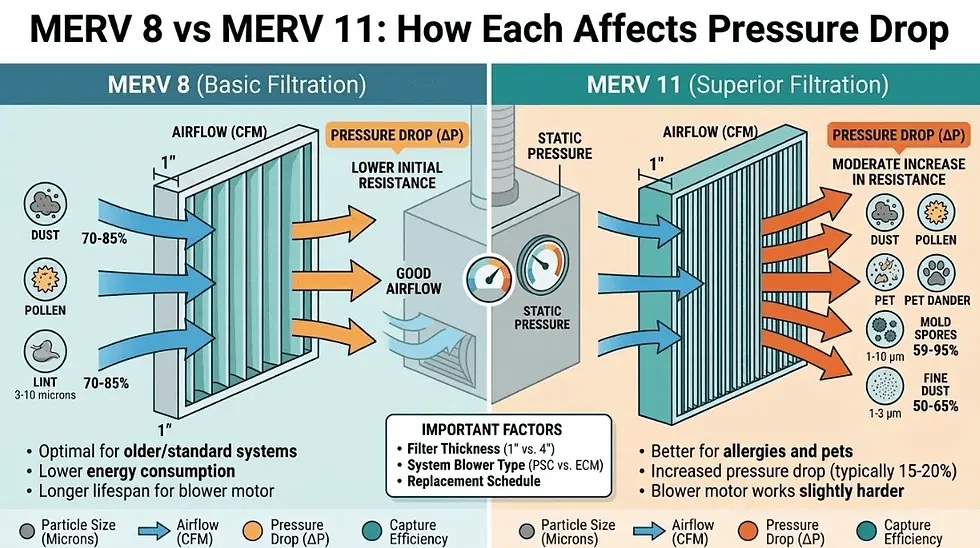
The key distinction comes down to fiber density and particle capture range. MERV 11 captures smaller particles precisely because its media is more tightly constructed — and that tighter construction is what creates greater resistance.
Here is how the two ratings compare across the factors that matter most:
Particle capture range: MERV 8 captures particles 3–10 microns; MERV 11 captures particles 1–3 microns and above
Pressure drop level: MERV 8 produces lower static pressure resistance; MERV 11 produces moderately higher resistance
Blower motor impact: MERV 8 places less strain on the motor; MERV 11 places more demand on systems with older or lower-capacity blowers
Energy efficiency: MERV 8 typically costs less to operate; MERV 11 may increase run time and energy draw
Ideal household profile: MERV 8 suits standard households with no acute air quality concerns; MERV 11 suits homes with pets, allergy sufferers, or higher particulate environments
Which Rating Is Right for Your Home?
After manufacturing filters for over a decade and analyzing what works across millions of real households, we've found that the right MERV rating depends less on which number is higher and more on what your system was designed to handle.
Choose MERV 8 if:
Your HVAC system is older or has a single-speed blower
Your home has smaller return ducts or a limited airflow capacity
Your household has no significant allergy or respiratory concerns
Energy efficiency and equipment longevity are top priorities
Choose MERV 11 if:
Your system is newer with a variable-speed or multi-speed blower
You have pets, allergy sufferers, or household members with asthma
Your home has above-average dust, dander, or fine particle loads
Your HVAC technician has confirmed your system can handle increased static pressure
When in doubt, we recommend confirming your system's maximum static pressure rating — found in your equipment's specifications — before stepping up from MERV 8 to MERV 11. That one step protects both your air quality and your equipment investment.
"After manufacturing filters for over a decade and working with more than two million households, the most consistent mistake we see is homeowners choosing a filter based on MERV rating alone — without ever considering how that filter's pressure drop interacts with their specific system's airflow capacity; the right filter isn't always the highest-rated one, it's the one your HVAC system can actually breathe through." — Filterbuy Air Quality Expert
Essential Resources for Understanding MERV 8 vs MERV 11 Pressure Drop
After manufacturing filters for over a decade and helping more than two million households make smarter filter decisions, we know that choosing between MERV 8 and MERV 11 goes beyond the rating on the package. The resources below give you the full picture — from how pressure drop is measured to what your specific HVAC system can actually handle.
1. MERV 8 vs MERV 11 Pressure Drop Chart — Filterbuy
We built this resource specifically for homeowners who want to see the real numbers — not just ratings. It breaks down pressure drop by filter size, airflow rate, and pleat design, with clear guidance on spotting airflow symptoms before they become costly equipment problems.
URL: https://filterbuy.com/resources/air-filter-basics/merv-8-vs-merv-11-air-filter-pressure-drop-chart/
2. MERV 8 vs MERV 11: The Complete Side-by-Side Comparison — Filterbuy
Built from over a decade of manufacturing data and real-world feedback from millions of customers, this comparison breaks down particle capture ranges, filtration efficiency, and system compatibility so you can choose the rating that protects your family without straining your equipment.
3. What Is a MERV Rating? — U.S. Environmental Protection Agency
Before comparing ratings, it helps to understand exactly what they measure. This EPA resource defines the MERV scale, explains what particle sizes each range captures, and clarifies why filter efficiency has a direct impact on both your indoor air quality and your HVAC system's long-term health.
4. Air Cleaners and Air Filters in the Home — U.S. Environmental Protection Agency
One of the most important things we tell homeowners is this: not every system can handle a higher MERV filter. This EPA consumer guide covers filter selection, MERV rating guidance, and the critical warning that upgrading without checking your system's capacity can restrict airflow and accelerate equipment wear.
5. Indoor airPLUS Filtration Technical Bulletin — U.S. Environmental Protection Agency
This EPA technical bulletin is the resource we point to when homeowners want government-backed data on pressure drop and system design. It includes specific MERV 11 particle removal figures and expert direction on sizing duct systems around maximum static pressure limits — exactly the kind of detail that protects both your air quality and your equipment investment.
6. ANSI/ASHRAE Standard 52.2 — Method of Testing General Ventilation Air-Cleaning Devices
Every MERV rating on every filter we manufacture is assigned and verified against this standard. ASHRAE 52.2 governs how filters are tested for both particle capture efficiency and resistance to airflow — making it the definitive source for understanding why two filters carrying the same MERV rating can perform very differently inside your system.
7. HVAC Filter Pressure Loss and Blower Motor Performance — U.S. Department of Energy
In our experience, the most overlooked factor in any filter upgrade is how the added resistance interacts with the blower motor powering your system. This DOE technical resource explains the critical difference between PSC motors — which lose airflow as filter resistance increases — and ECM variable-speed motors, which compensate but draw significantly more energy in doing so.
Supporting Statistics
The data behind MERV 8, MERV 11, and pressure drop reveals why your filter decision matters far beyond a clean return vent.
Statistic 1: Indoor air is often 2 to 5 times more polluted than outdoor air — and Americans spend 90% of their time breathing it.
Americans spend approximately 90% of their time indoors, where concentrations of some pollutants are often 2 to 5 times higher than typical outdoor concentrations.
What that means from our perspective after serving more than two million households:
Most homeowners monitor outdoor AQI closely but rarely think about what's cycling through their own ductwork
Every breath your family takes at home passes through your HVAC filter first
The invisible air inside your home is often more polluted than the air outside your front door
Whether MERV 8 or MERV 11 is right for your system determines how well that front line actually holds
Source: U.S. Environmental Protection Agency — Indoor Air Quality https://www.epa.gov/report-environment/indoor-air-quality
Statistic 2: Heating and cooling account for approximately 35% of all U.S. energy consumption — making filter-driven pressure drop a direct cost to every homeowner.
The energy devoted to heating and cooling buildings accounts for around 35% of all energy consumption, the largest share attributable to any end use.
Here is what excess pressure drop actually costs, based on what we've observed across homes nationwide:
The blower motor works harder, runs longer, and draws more power with every cycle
The energy penalty accumulates quietly — often for months before anyone notices
A MERV 11 filter in the wrong system may show no obvious warning signs early on
The wear on an overworked blower motor doesn't reverse itself
The bottom line: matching your filter's pressure drop to your system's capacity isn't an upgrade decision. It's a cost protection decision.
Source: U.S. Department of Energy — Heating, Ventilation, Air Conditioning, Refrigeration, and Water Heating https://www.energy.gov/eere/buildings/heating-ventilation-air-conditioning-refrigeration-and-water-heating
Statistic 3: Approximately 25 million Americans — 7.7% of the U.S. population — currently have asthma, a condition directly aggravated by the airborne particles the right MERV rating captures.
About 25 million Americans, representing 7.7% of the U.S. population, had asthma in 2021 — an increase from 20.3 million in 200.
What years of working directly with these households have taught us:
For families managing asthma or allergies, a filter isn't a commodity — it's a daily health intervention
MERV 11 captures particles down to 1 micron, including the pet dander, mold spores, and fine dust most likely to trigger symptoms
But that benefit only reaches your family if the system is moving air efficiently
A MERV 11 filter fighting excess pressure drop doesn't protect anyone
The right filter decision requires understanding both sides of the equation:
Filtration efficiency — what the filter captures
Airflow integrity — whether your system can breathe through it
Source: U.S. Centers for Disease Control and Prevention — Asthma Surveillance in the United States 2001–2021 https://www.cdc.gov/asthma/asthma-prevalence-us-2023-508.pdf
Final Thoughts
After manufacturing air filters for over a decade and working with more than two million households, one pattern has stayed remarkably consistent: homeowners research MERV ratings thoroughly — and almost never research pressure drop.
That gap is where real problems quietly begin.
Our honest, experience-based opinion:
The air filter industry does a poor job of making pressure drop visible to the people it affects most. Filtration efficiency gets the headline. Pressure drop gets the footnote. But inside your HVAC system, pressure drop determines whether a better filter actually improves your air — or simply makes your equipment work harder for the same result.
What over a decade of manufacturing has taught us:
A MERV 8 filter in the right system outperforms a MERV 11 filter in the wrong one — every time
The best filter isn't the highest number on the shelf — it's the highest number your system can breathe through efficiently
Pressure drop accumulates its damage slowly, invisibly, and expensively — long before a service call gets scheduled
Homeowners who protect both air quality and equipment are the ones who treat these two variables as inseparable
Our position hasn't changed in over a decade:
Clean air and system health are not competing priorities. They are the same priority. A filter that cleans your air while quietly strangling your HVAC system isn't doing its job — regardless of the rating printed on the frame.
The Prudent Protector's filter decision comes down to two things:
Choose the highest MERV rating your system can handle efficiently
Verify pressure drop compatibility before upgrading — not after
The homeowner who understands both filtration efficiency and pressure drop doesn't just buy a better filter. They make better decisions.
FAQ on MERV 8 vs MERV 11 Pressure Drop
Q: What is pressure drop and why does it matter when comparing MERV 8 vs MERV 11?
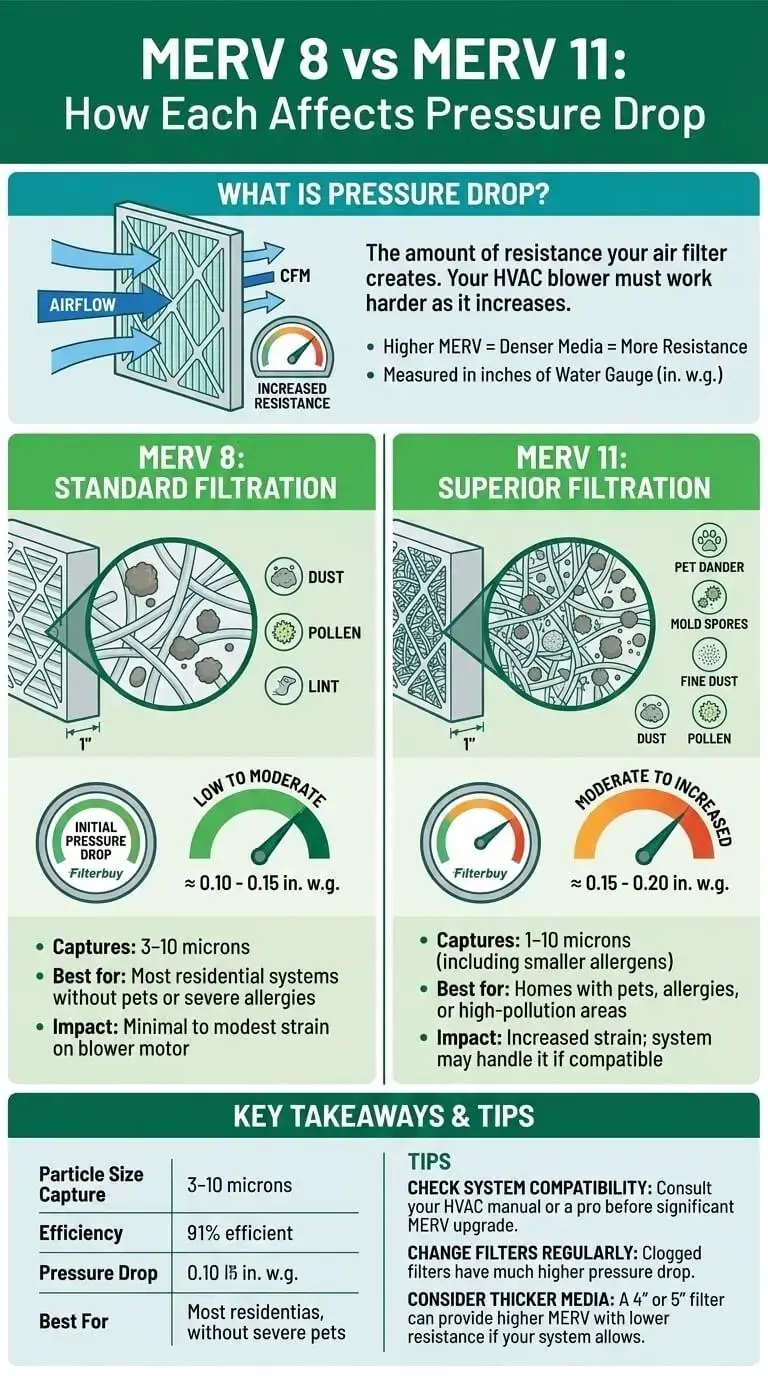
A: Pressure drop is the resistance a filter creates as air moves through its media. The denser the fiber structure, the harder your blower motor works to move the same volume of air.
Why it matters more than most filter guides admit:
MERV ratings tell you what a filter captures
Pressure drop tells you what that filtration costs your system
MERV 11's tighter media captures finer particles — and creates more resistance than MERV 8
That resistance drives longer run cycles, higher energy draw, and accelerated blower motor wear
After manufacturing filters for over a decade and serving more than two million households, pressure drop is the variable we see overlooked most consistently — and the one that causes the most preventable problems after a filter upgrade.
Q: Does a MERV 11 filter significantly increase pressure drop compared to MERV 8?
A: Yes — but how significantly depends on factors beyond the MERV number itself.
What drives pressure drop at any MERV rating:
Fiber density and media construction
Pleat count and pleat depth
Filter face size and overall surface area
System airflow rate (CFM)
What this means in practice:
A well-engineered MERV 11 filter can produce lower pressure drop than a poorly designed MERV 8
Two MERV 11 filters from different manufacturers can behave entirely differently in the same system
The pressure drop specification — found in the product data sheet — tells you more than the MERV rating alone
System compatibility by motor type:
Variable-speed ECM motors: Generally handle MERV 11 pressure drop without significant airflow loss
Single-speed PSC motors: Deliver less air as resistance increases — no compensation mechanism exists
Q: How do I know if my HVAC system can handle a MERV 11 filter without suffering from excess pressure drop?
A: Three steps that remove the guesswork — based on what we've observed across millions of household filter changes:
Check your equipment manual for maximum static pressure rating. This number — expressed in inches of water column (in. w.c.) — is your blower motor's upper resistance limit. Most homeowners have never seen it. Most filter packaging never references it.
Know your motor type before upgrading.
PSC motors (pre-mid-2000s systems): Lose airflow directly as resistance increases
ECM variable-speed motors: Maintain airflow but draw more energy under higher resistance
Monitor system behavior in the first 30 days after upgrading. Watch for:
Longer run cycles
Rooms that won't reach set temperature
Weaker airflow from supply vents
Unexplained increases in energy bills
These are the system's early warning signs that pressure drop is exceeding its designed tolerance.
Q: Is MERV 8 good enough for a home with pets or allergy sufferers, or is MERV 11 worth the added pressure drop?
A: For most households with pets or allergy sufferers, MERV 11 is worth it — but only when the system supports it.
Choose MERV 8 if:
Your system is older with a single-speed blower
Existing airflow limitations are already present
No acute respiratory concerns exist in the household
Equipment longevity and energy efficiency are the priority
MERV 8 captures particles down to 3 microns — covering most pollen, dust mites, and mold spores
Choose MERV 11 if:
Your system is newer with a variable-speed ECM blower
Household members have asthma, allergies, or respiratory sensitivities
Multiple pets are generating fine dander
Static pressure compatibility has been confirmed
MERV 11 captures particles down to 1 micron — meaningfully broader protection for sensitive households
The insight we share most consistently after serving millions of households: MERV 11's health benefits are real — but they're conditional. A MERV 11 filter in a system struggling with excess pressure drop isn't delivering superior filtration. It's delivering reduced airflow with a higher number on the frame.
Q: Does filter thickness affect pressure drop when comparing MERV 8 and MERV 11?
A: Significantly, and filter thickness is the most underutilized variable available to homeowners trying to balance better filtration with lower pressure drop.
Here is why thickness matters:
A thicker filter has more surface area
More surface area means each square inch handles less of the total airflow
Less airflow per square inch means lower media velocity
Lower media velocity means lower pressure drop
The result that consistently surprises homeowners:
A 4-inch MERV 11 filter frequently produces equal or lower pressure drop than a 1-inch MERV 8 filter
The upgrade to better filtration doesn't have to come with a pressure drop penalty
Filter depth can resolve the MERV 8 vs MERV 11 tradeoff entirely — if the cabinet accommodates it
Three questions to ask before dismissing MERV 11 on pressure drop grounds:
What is my current filter depth?
Does my filter cabinet accommodate a 2-inch, 4-inch, or 5-inch filter?
Have I compared pressure drop specifications — not just MERV ratings — between my current filter and the upgrade?
After a decade of manufacturing filters across hundreds of sizes, exploring filter thickness before defaulting to a lower MERV rating is one of the most consistently valuable recommendations we make.
Ready to Find the Right Filter for Your System's Pressure Drop?
Now that you understand how MERV 8 and MERV 11 affect pressure drop differently, take the next step toward protecting both your family's air quality and your HVAC system — shop Filterbuy's full selection of MERV 8 and MERV 11 filters, available in hundreds of standard and custom sizes, manufactured in America and delivered directly to your door.


Comments