


Can an Air Filter Maintenance Checklist Help with Stopping Mold from Spreading?
Every week, pleated filters come back to our facilities with gray staining around the pleats, dark speckles across the media, and a soft halo of green where moisture has settled in. Most spent six months too long in a humid air handler. Most of those homeowners had no idea anything was wrong. The right filter, swapped on a schedule you actually keep, traps airborne mold spores before they cycle through your house another hundred times. The maintenance routine below is what our customer-service team walks people through when a homeowner calls us about a musty smell coming out of a vent.
TL;DR Quick Answers
Can An Air Filter Help With Mold?
Yes. A MERV 11 or MERV 13 pleated filter in your furnace or air handler catches most airborne mold spores, which measure between 2 and 10 microns wide. A true HEPA portable purifier pulls 99.97% of particles down to 0.3 microns and works best for protecting a single room. Neither one fixes the moisture problem that lets mold grow in the first place. The maintenance steps further down are what get those filters doing their job.
Top 5 Takeaways
Airborne mold spores measure 2 to 10 microns wide. MERV 11 and MERV 13 pleated filters trap them on every system cycle.
A true HEPA air purifier captures 99.97% of particles at 0.3 microns, including the dried spore fragments left after a vacuuming or cleaning disturbance.
No filter fixes a wet wall, a clogged condensate drain, or a leaky duct. Moisture control comes first, and the filter handles what is already airborne.
Indoor humidity above 60% turns any HVAC system into mold-friendly territory. The filter rating matters very little if the air around it is wet.
A monthly visual filter check plus a swap every 60 to 90 days stops most spore recirculation before it spreads through the rest of the house.
How Mold Spores Travel Through Your HVAC System
Mold spores get into your house every day. They drift in on outdoor air through open windows and doors, hitch a ride on shoes and pet fur, and wait for a damp surface to land on. Once a colony takes hold somewhere indoors (usually in a basement wall, a bathroom corner, or attic insulation under a small roof leak), your HVAC system quietly distributes that spore load across the rest of the house.
The return air intake pulls spores off surfaces and into the duct trunk. The blower pushes them across the cooling coil, where condensation occasionally lets new colonies start. Supply ducts then carry that spore-laden air into every room, several times an hour, every time the system runs.
We talk to humid-climate customers every week, mostly in Florida, Louisiana, and across the Gulf Coast. The pattern is consistent. A homeowner finally pulls the filter, sees the color, and realizes the air handler has been pushing spore-laden air through the house for months. The filter has been doing its job when it stains. The problem only starts when nobody pulls it to look.

What MERV Rating Captures Mold Spores
MERV stands for Minimum Efficiency Reporting Value, the industry-standard scale published by ASHRAE. The higher the number, the smaller the particle the filter can catch. Here is what each common residential rating actually handles when mold is the concern.
MERV 8 catches larger spores and dust mite debris but misses many of the smaller spore fragments. Reasonable for a household with no mold concerns and an older, more sensitive blower.
MERV 11 captures roughly 85% of particles between 3 and 10 microns. Strong middle ground for most households and a meaningful step up against mold.
MERV 13 is the residential ceiling ASHRAE recommends. It catches most particles down to 0.3 microns with useful efficiency, which includes spores, smoke, and a portion of bacteria.
We recommend MERV 13 to most households with allergies, asthma, pets, or anyone living in a humid climate. If your system is older or its filter slot is built for thinner media, MERV 11 is the safer choice. Pushing a rating beyond what your blower was built for restricts airflow and creates the same coil condensation problem you are trying to prevent in the first place.
HEPA Versus MERV Filters For Mold Spores
HEPA and MERV filters are designed for different jobs in the same fight against airborne mold.
A MERV-rated filter lives inside your HVAC system. It treats the air in every room each time the system cycles, which is the practical way to lower the whole-house spore load. A true HEPA filter lives inside a portable air purifier or a dedicated medical-grade unit, capturing 99.97% of particles at 0.3 microns, the toughest size for any filter to grab. HEPA media works especially well on the smaller fragments left after a mold disturbance, like vacuuming a damp carpet.
Pair the two. MERV 13 in your air handler treats the whole house every cycle. A portable true HEPA unit in an allergy sufferer’s bedroom, a finished basement, or a nursery handles room-level air at near-total efficiency. And do not try to swap a HEPA filter into a furnace slot. Residential blowers cannot pull air through HEPA media at the density required, and the system will starve for airflow.
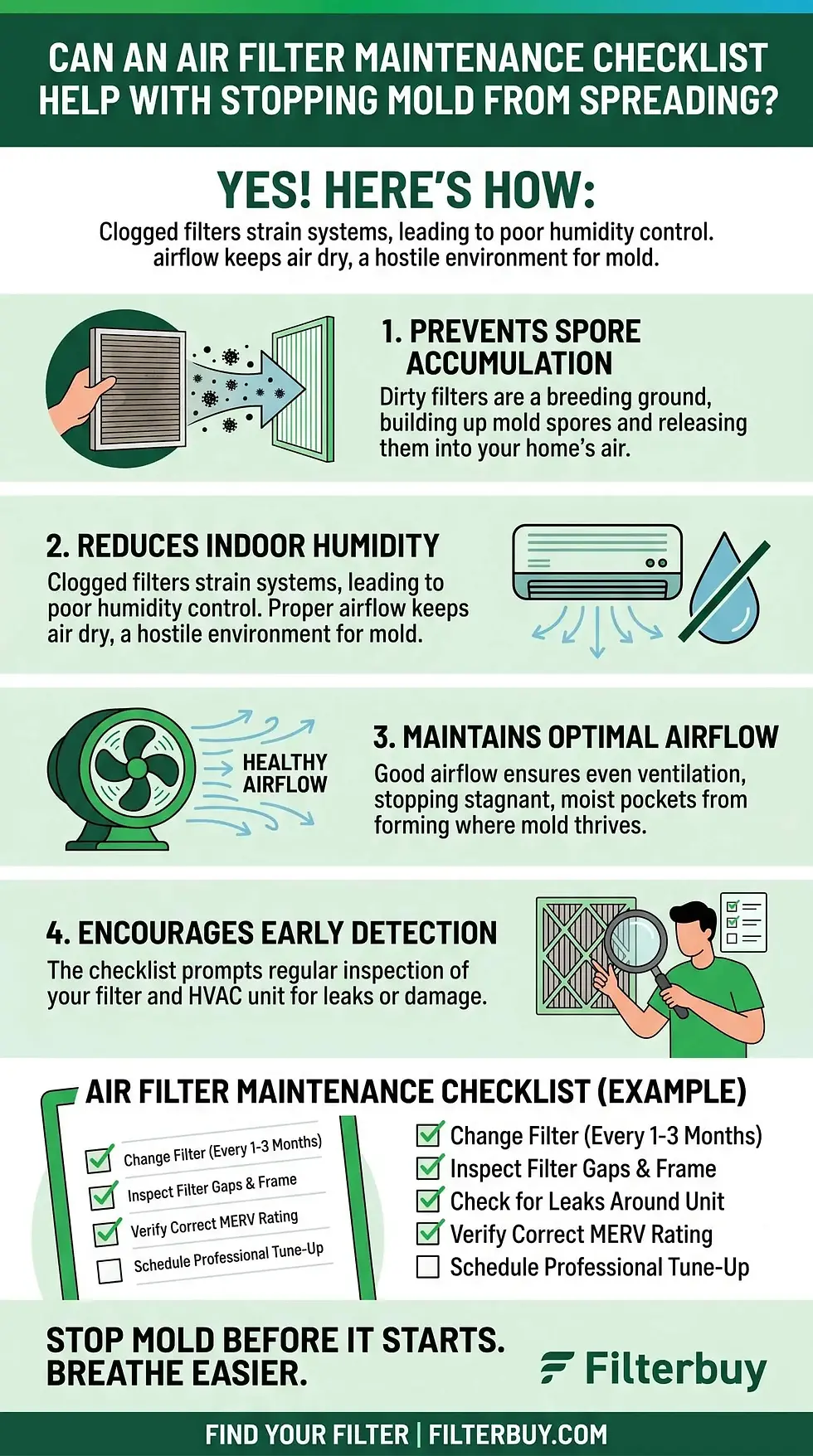
The Air Filter Maintenance Checklist For Stopping Mold
Run this routine monthly, and you will catch most filter-related mold issues long before they spread.
Pull the filter and look at the face. Gray dust is normal wear. Dark spots, slimy patches, or a wet feel mean replace immediately and inspect what is upstream.
Replace pleated filters every 60 to 90 days under typical conditions. Move every 30 to 45 days during humid months, after wildfire smoke events, or if anyone in the household has allergies or asthma.
Check the gasket seal around the filter frame. Any gap lets unfiltered air bypass the media and run straight into the coil. Reposition the filter or upsize until it sits flush.
Inspect the condensate drip pan and drain line at each season change. Standing water is a mold-friendly habitat. Pour a cup of distilled vinegar down the line or use an approved drain treatment.
Look at the evaporator coil for visible film or growth. Dirty coils stay wet longer and become a substrate for new colonies.
Confirm your indoor humidity stays between 30% and 50%. A $15 hygrometer is all you need. Add a dehumidifier or run the AC longer in shoulder seasons if the reading drifts up.
Walk the ductwork at any accessible point and feel for cold sweating. Insulate any uninsulated section that runs through an unconditioned space.
Schedule a professional HVAC inspection annually, or every six months in coastal and Gulf Coast climates. Ask the technician to check the drain pan slope and clean the blower wheel.
Write the date of each filter change on the filter frame or set a calendar reminder. Forgotten filters are the most common failure point we see.
When A Filter Is Not Enough For Mold
The EPA’s position is plain. Mold control starts with moisture control. A filter handles what is already in the air. Stopping mold from generating in the first place means cutting off the water it needs to grow on a surface.
The four moisture entry points we see most often in customer homes:
Roof and plumbing leaks that drip slowly into wall cavities or attic insulation
Foundation grading that slopes toward the house instead of away from it
Cold-surface condensation on uninsulated ducts, windows, or basement walls
Humid air from cooking, showering, and indoor drying that no exhaust fan ever clears out
Any water event needs to be dried within 24 to 48 hours, or mold gets a head start that no filter can undo afterward. If you see visible growth on the inside of a duct, on the coil itself, or on duct insulation, the system needs professional remediation. A new filter on a contaminated air handler will only collect spores faster.
“After manufacturing filters for over a decade and serving more than two million households, the mold problems I see in the field almost always come down to one of two things: a filter that ran two months too long in humid weather, or one that never sealed tight against its frame. A MERV 11 or MERV 13 swapped on time and seated correctly fixes both.” — David Heacock, Founder and CEO, Filterbuy
Essential Resources: Can An Air Filter Help With Mold?
Seven trusted government and nonprofit sources to keep on hand as you find the answer to the question: Can an air filter help with mold and other related questions? Each one fills a gap that the others do not.
1. How Air Cleaners Actually Handle Mold (And Where They Stop)
EPA’s official position on portable air cleaners and HVAC filters. Useful for capturing some of the particles mold puts into your air, but never a substitute for fixing the water source feeding the colony itself.
2. How Mold Gets Inside Through Vents, Ducts, And Open Doors
CDC’s plain-language overview of how mold enters homes through HVAC openings, doors, windows, pets, and clothing, plus what damp indoor environments do to respiratory health across age groups.
3. The Direct Link Between Mold And Asthma Flare-Ups
American Lung Association explainer on how mold spores trigger allergic asthma and which household mitigation steps make the biggest difference for sensitive family members.
4. A Patient's Guide To Living With Mold Allergy
Asthma and Allergy Foundation of America’s patient-focused guide to common indoor mold species, symptom patterns, and at-home prevention steps that families can run on their own schedule.
5. HUD Mold Removal Guidelines For Flood And Water Damaged Homes
HUD’s plain-language reference on mold removal after a flood, covering exposure risks, do-it-yourself cleanup steps, the materials worth saving versus discarding, and the point at which to bring in a licensed remediation contractor.
6. The Clinical Side Of Mold Allergy And Asthma
Mayo Clinic’s clinical overview of mold allergy symptoms, related complications like allergic fungal sinusitis, and the conditions that worsen with airborne spore exposure.
7. Step-By-Step At-Home Mold Prevention From The NIH
MedlinePlus, the patient education service from the National Institutes of Health, walks through allergies, asthma, and molds with practical at-home prevention steps a household can run without specialized equipment.
Supporting Statistics
Three figures from independent government sources that frame the scale of indoor mold risk and the place a filter holds inside that picture. Every number cited has been pulled from the source we link to, not paraphrased from a third party.
1. The Asthma Risk Of Living With Dampness And Mold
A meta-analysis of 16 epidemiologic studies found an average 50% increase in the risk of developing asthma associated with home dampness or mold exposure.
Mold odor alone was tied to a 73% increase in asthma risk, even when the mold itself was not visible to the household.
What this means for households: if you can smell mold, your air filter has been doing extra work for weeks already.
2. How Many Americans Are Already Sensitive To Indoor Biologicals
Biological pollutants (which include molds, bacteria, viruses, dust mite allergen, and pollen) play a key role in triggering asthma episodes for an estimated 15 million Americans.
That same group of pollutants tends to accumulate when HVAC systems run with dirty filters, poor humidity control, or condensation buildup on coils and drip pans.
3. The Cost Of Skipping Filter Maintenance
DOE reports that a clogged, dirty filter slows normal airflow and forces the air handler to work harder, cutting efficiency and contributing to indoor air quality problems.
The same agency notes that routine filter replacement is one of the most important maintenance tasks for keeping an HVAC system running at design performance.
From our manufacturing side: an overdue filter is doing damage in two directions at once, to your air and to the equipment that moves it.
Final Thoughts And Opinion
The mistake we see most often is treating air filtration as the whole story on mold. Filtration matters, and the right rating does real work. But it cannot outrun a leaking basement wall. A MERV 13 filter on top of standing water just becomes a sponge for the spores you keep generating.
The households we see succeed treat the filter and the building as one system. They keep a hygrometer reading on every floor, write the install date on every filter, and check the drip pan with the same regularity most people give their smoke detectors. None of that takes specialized knowledge. It takes a routine and a willingness to open parts of the home most people leave alone.
You already protect your family in a dozen ways every week. This checklist is one more habit, and a small one. Over time, it pays back in cleaner air for your household and an HVAC system that lasts longer because nothing damp is sitting on its coils.
Frequently Asked Questions
Q: Do air purifiers help with mold allergy symptoms?
A: Yes, when the purifier uses a true HEPA filter rated to capture 99.97% of particles at 0.3 microns. Run it in the room where allergic family members sleep or spend the most time. The unit will not stop new spores from forming if there is still a damp surface somewhere in the house.
Q: What is the best air filter for black mold?
A: A MERV 13 pleated filter handles the airborne phase of any visible mold, including the species commonly called black mold. The filter is not a cleanup tool. Visible black mold growth on walls, ducts, or insulation calls for professional remediation before anything else.
Q: Can a whole-house air filter remove mold from every room?
A: A whole-house MERV-rated filter captures most airborne spores every time the HVAC system cycles, which is several times an hour. It cannot remove mold that has already colonized a surface or fix the moisture problem that feeds it. Pair the filter with humidity control and prompt leak repair for full coverage.
Q: Is a furnace filter the same as an air filter for mold?
A: For most homes, yes. The filter slot in your furnace or air handler is where your HVAC filter lives, and that same filter is the one doing the work against mold spores when the system runs. The labels furnace filter and HVAC filter describe the same product on a residential system.
Q: Can an air filter cause mold to grow inside the HVAC system?
A: A clean, dry filter cannot. A filter left in place past its replacement date in a humid system can, because trapped dust collects moisture and becomes a substrate for mold growth on the filter media itself. The maintenance checklist above is built to prevent exactly that scenario.
Q: How do I remove mold spores from the air in a basement?
A: Run a MERV 13 filter in your HVAC system if the basement shares the same air handler as the rest of the house. Add a portable true HEPA unit in the basement itself. Set a dehumidifier to hold humidity at 50% or lower. Fix any active water source before anything else, since basements are usually the first room where moisture problems tend to show up.
Q: Should I use a MERV 13 filter if I suspect mold in my home?
A: MERV 13 is the rating ASHRAE recommends for residential systems, and it is the one we steer most mold-concerned customers toward. Check your HVAC manual or filter slot label first. If the system is older or rated for thinner media, MERV 11 is the safer choice and still captures the majority of airborne spores.
Q: How often should I change my filter when allergies flare up?
A: Move from a 60-to-90-day schedule to every 30 to 45 days during a flare. Pull the filter weekly and look at it while symptoms are bad. Visible discoloration, dampness, or any musty smell coming from a vent is the cue to swap right away rather than wait for the calendar to catch up.
Better Air Starts With The Right Filter
Shop Filterbuy MERV 13 pleated filters and run them on the maintenance schedule above to keep airborne mold spores out of your HVAC system. Every filter is built in our U.S. facilities, sized to fit your slot, and shipped directly to your door.


Comments