


Best Air Cleaner For New Homeowners Concerned About Mold From Construction
Walk past any new subdivision being framed in May, and you'll see the same scene. Stacks of dimensional lumber sitting on bare dirt. A tarp that holds water like a kiddie pool. Boards already starting to gray on the bottom. That wood goes into the walls of homes closing in October. By February, the new owners are calling us about a musty smell in the basement that nobody can track down.
Mold in a brand-new house catches people off guard. The walls look fresh. The appliances still have plastic on them. Nothing looks wrong. But the conditions mold needed were locked in months before the moving truck arrived. Picking the best air cleaner for mold belongs near the top of every new homeowner's move-in list, particularly during the first six to twelve months, while trapped construction moisture is working its way out.
TL;DR Quick Answers
Best Air Cleaner For Mold
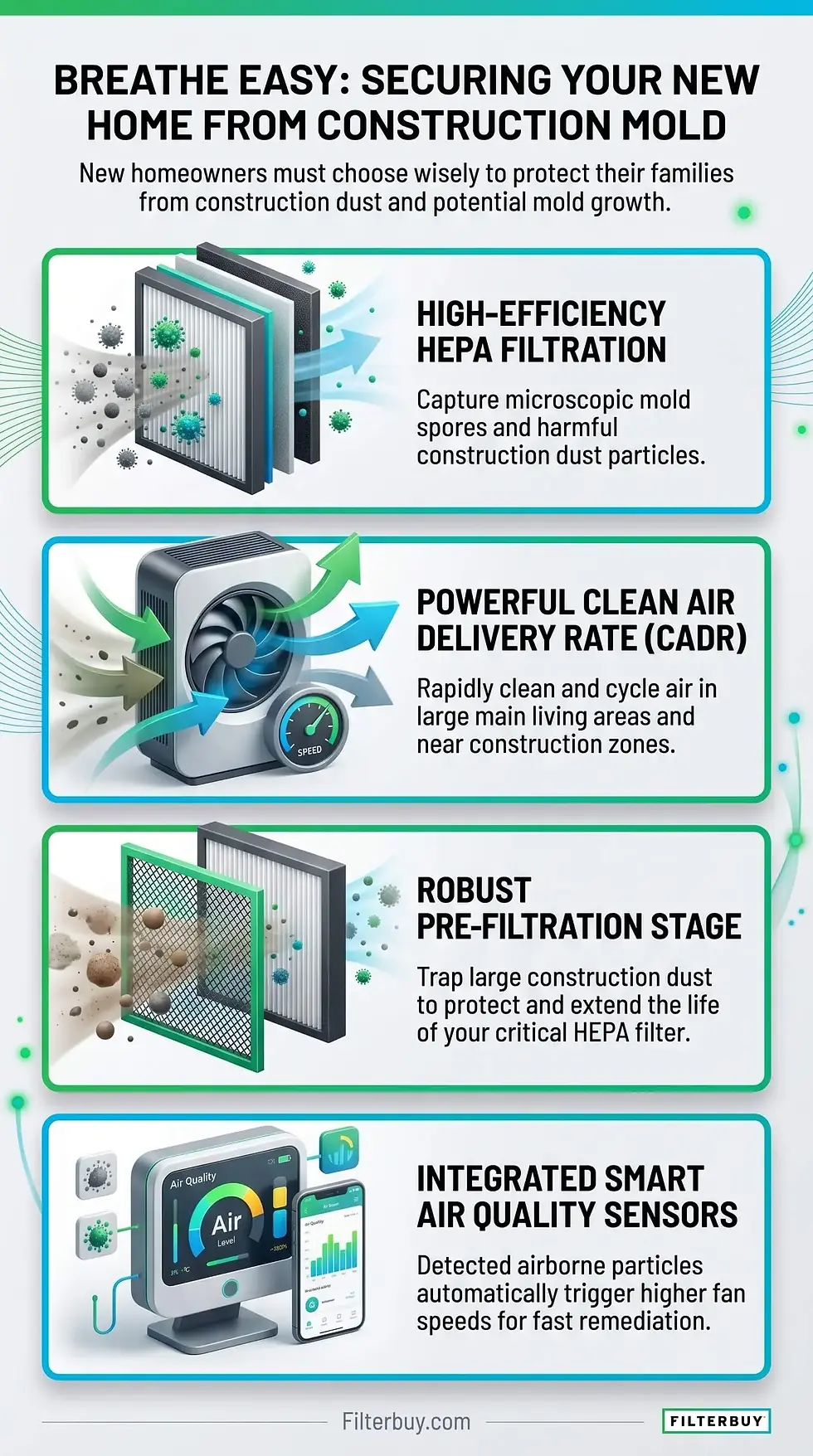
Pair a true HEPA room air cleaner with a MERV 11 or MERV 13 HVAC filter. The room unit captures 99.97 percent of particles at 0.3 microns, which covers the full mold spore size range. The HVAC filter handles whole-house circulation every time the blower runs. In basements or other humidity hot spots, add a dehumidifier to hold relative humidity between 30 and 50 percent. That three-piece setup is what we recommend for any new build.
Top 5 Takeaways
New construction traps mold spores. Wet lumber, sealed envelopes, and HVAC startup conditions create moisture pockets before the first family meal is cooked.
True HEPA is the proven standard. A sealed HEPA cleaner captures 99.97 percent of particles at 0.3 microns, well inside the 1 to 30 micron range of common indoor mold spores.
MERV 11 to 13 covers the whole house. Upgrading your HVAC return filter cuts airborne spores every time the blower cycles on.
Moisture control comes first. Air cleaners pull spores from the air. They cannot kill mold growing on a wet stud bay or behind a baseboard. Fix leaks and dry materials before relying on filtration.
Keep humidity between 30 and 50 percent. That EPA target stops most mold from establishing, which makes every other defense easier.
Why New Homes Carry Hidden Mold Risk
Builders work to tight schedules, and lumber often shows up at the site weeks before crews are ready to frame. We have watched stacks sit on bare dirt under tarps that trap rain like swimming pools. Per EPA guidance, mold can start growing on wet wood within 24 to 48 hours, and the same window applies to drywall, insulation, and subflooring exposed during construction. Once those materials get sealed inside walls, any spores that took hold ride along into the finished home.
Energy-efficient construction tightens the screws further. Builders deliberately seal today's homes to cut air leakage, which works wonders on the utility bill and rough on trapped moisture. Newly fired-up HVAC systems often run while building materials are still off-gassing, pulling humid air through fresh ductwork and dropping condensation in cool spots.
From our work supplying filters to families during the first year of homeownership, the pattern is consistent. Musty smells show up four to eight months after closing. Allergy flare-ups concentrate in one or two rooms. Visible spotting appears near windows or in basement corners. The builder did not necessarily do anything wrong. New construction is just a vulnerable window, and the homeowner is in the best position to interrupt it.
How Air Purifiers Work Against Mold Spores
Mold spores measure between 1 and 30 microns across, with most indoor varieties landing between 2 and 10 microns. That puts them squarely in the capture range of high-efficiency filtration. A true HEPA air purifier pulls room air through dense pleated media that captures 99.97 percent of particles at 0.3 microns, the toughest size to trap. Spores are bigger, so they come out even more easily.
The flow is simple. Air enters the unit. A pre-filter grabs hair and visible dust. The HEPA media then locks spores into its fibers through interception, impaction, and diffusion. Clean air exits. The cycle repeats. When musty odors are part of the problem, look for a unit with an activated carbon stage. Carbon adsorbs the microbial volatile organic compounds that give active mold its distinctive smell.
What an air purifier cannot do matters just as much as what it does. It will not kill mold growing on drywall, in carpet padding, or inside a wall cavity. It will not solve a humidity problem. And it should never generate ozone as a byproduct. The EPA has been clear that ozone-producing air cleaners can irritate lungs without doing much to reduce actual mold. Stick with mechanical HEPA filtration backed by the right HVAC filter. For more on the underlying technology, the Wikipedia entry on the air filter walks through the engineering.
Best MERV Rating For Mold In Your HVAC System
MERV, the Minimum Efficiency Reporting Value, measures how much of a given particle size a filter catches. For mold, the practical floor is MERV 11. ASHRAE recommends MERV 13 as the residential standard for indoor air quality, and most HVAC systems built in the last decade handle it without airflow trouble.
Here is how the common ratings perform against mold spores in the 1 to 3 micron range, which is where most indoor varieties sit:
MERV 8: Catches larger spores and dust but lets a meaningful share of smaller spores through. Acceptable as a baseline. Weak for mold concerns.
MERV 11: Captures 65 to 85 percent of particles in the 1 to 3 micron range. Strong performance with manageable airflow impact on most residential systems.
MERV 13: Captures over 85 percent of particles in the 1 to 3 micron range and around 50 percent in the 0.3 to 1 micron range. The ASHRAE-recommended residential standard.
Two notes from years of fitting filters into customer systems. First, check your HVAC manual or read what came out of the existing filter slot before jumping to MERV 13. Some older single-stage furnaces lose airflow with high-MERV filters and do better at MERV 11. Second, plan to swap pleated filters every 60 to 90 days during the first year of new-home occupancy. Construction dust and spore loads run higher than steady-state and load filters faster. For a deeper read on filter selection, see our guide to the best MERV filters for mold spores.

Best Air Cleaner Setup For A New Home, Room By Room
Two layers cover a new home well. The HVAC return air filter handles whole-house circulation. Standalone HEPA cleaners handle the rooms where people actually spend hours at a time. Most families end up with two or three room units plus an upgraded HVAC filter to cover an average 1,800 to 2,400 square foot home.
Master bedroom and nursery. Put a true HEPA purifier in each sleeping area. Sleep is the longest block of time anyone spends in a single room, so consistent overnight filtration matters more than any sticker-rated coverage area. Size the unit by Clean Air Delivery Rate (CADR), and pick a smoke CADR at least two-thirds of the room's square footage. A 200 square foot bedroom wants a unit rated around 130 CADR or higher.
Basement and lower levels. Basements are mold's favorite zone in any home, doubly so in new construction, where the concrete is still releasing curing moisture, and the waterproofing has not been tested by a full rainy season. Add a HEPA purifier with an activated carbon stage to handle musty odors. This is the air purifier for the basement mold scenario most homeowners ask us about, and a basement unit should always run alongside a dehumidifier.
Open-plan living areas. Pick one high-CADR unit rather than two smaller ones. Air mixing across an open floor plan works in your favor when the unit is sized correctly for the total square footage.
Kitchens and bathrooms. Skip the standalone purifier here. Use the existing exhaust fans hard during cooking and after every shower. Exhaust ventilation removes moisture before it can become a mold problem.
Mold and mildew tend to show up together in damp zones, so the best air purifier for mold and mildew is the one positioned closest to where moisture lingers longest. Black mold concentrates on persistently wet cellulose, like drywall paper, which makes the best air purifier for black mold a unit positioned downstream of any remediation work.
Air Purifier Or Dehumidifier For Mold
Dehumidifier first. Air purifier second. Mold needs wet surfaces to grow, so pulling out the moisture removes the conditions mold needs to establish in the first place. An air purifier catches the spores already drifting around, but it cannot solve a humidity problem.
The EPA target for indoor relative humidity is 30 to 50 percent. New homes often run higher than that in year one because building materials are still releasing moisture as they cure. A basement holding 65 percent humidity through summer is a mold incubator regardless of how many HEPA units sit in the corner.
Sequence for a new-construction home:
Place a dehumidifier in the basement and any humidity hot spot, sized for the square footage.
Confirm bathroom and kitchen exhaust fans vent to the outside, not into the attic.
Place HEPA air purifiers in bedrooms and primary living spaces.
Upgrade the HVAC return filter to MERV 11 or MERV 13.
Track relative humidity with an inexpensive hygrometer for the first six months.
Running the dehumidifier and the air purifier together is the move that delivers measurable results in basements and through the humid stretch of summer.
When To Call A Professional
Filtration handles airborne spores. A few situations need a remediation professional, regardless of how well your filters are performing:
Visible mold covering more than about 10 square feet, the EPA threshold for professional remediation.
Persistent musty odors that do not trace to an obvious source after a basic walkthrough.
Documented water intrusion, plumbing leaks, or post-flood cleanup.
Allergy or respiratory symptoms that do not improve after filtration and moisture control are both in place.
Most new-home owners never hit this threshold. The filtration and moisture steps we have covered keep small problems from becoming visible ones. A new home is the best chance you will ever have to get ahead of mold before it shows up on a wall.
“After manufacturing filters for over a decade and serving more than two million households, I have noticed new-construction homes drive a predictable wave of basement air-quality calls between months four and eight after move-in. A true HEPA cleaner paired with a MERV 13 filter catches what construction trapped inside the walls.”
Essential Resources On the Best Air Cleaner For Mold
Trust your air quality decisions to source material that does not have a product to sell. The seven references below come from federal agencies, public-health authorities, and patient-advocacy organizations that publish their research and guidance in the open. These will help you determine the best air cleaner for mold inside your home.
Start With EPA's Foundational Mold Playbook
The EPA's mold guide is where most homeowners should start. It covers the 24-to-48-hour wet-materials rule, the 30 to 50 percent humidity target, and what you can clean yourself versus when to call a pro.
Understand Mold's Health Effects From The CDC
The CDC mold page lays out who is most at risk and which symptoms point to mold exposure. Worth reading if anyone in your household deals with allergies or asthma.
Read HUD's Mold Removal Guidance For Damp Conditions
HUD's field guide spells out what mold looks like, how moisture drives it, and the cleanup steps that actually work in real houses. Especially useful when you are handling a moisture event yourself.
Apply The Department Of Energy's Home Moisture Control Tips
The DOE moisture control page covers humidity targets, ventilation strategies, and the building-science basics that keep new homes dry. The guide your builder should already be using.
See How Dampness Affects Lung Health At The American Lung Association
Patient-facing reference on mold, dampness, and respiratory effects. Hand this to the family member who has been dismissing indoor air quality as overblown.
Check Your Mold Allergy Risk With The Asthma And Allergy Foundation
AAFA's mold allergy page covers symptoms, triggers, and household management. Useful for parents of kids who already deal with seasonal or environmental allergies.
See How Ventilation And Filtration Tie Together At The National Center For Healthy Housing
NCHH publishes evidence-based guidance on how home ventilation, filtration, and humidity control work together to keep indoor air healthy. The ventilation and indoor air quality page covers MERV ratings, duct sealing, HVAC sizing, and moisture conditions that drive mold growth in residential settings.
Supporting Statistics
A few numbers from independent research and standards bodies make the case for taking air filtration seriously in a new house.
WHO Confirms Widespread Indoor Dampness Across Modern Housing
Up to 50 percent of homes in some regions show signs of indoor dampness, according to the World Health Organization, which links damp indoor environments to higher rates of respiratory infections, asthma symptoms, and other adverse outcomes. From what we see in the field, new-construction basements drive most of the year-one cases that families notice.
ASHRAE Names MERV 13 The Residential Standard For Mold-Sized Particles
ASHRAE recommends MERV 13 as the residential HVAC standard for indoor air quality, citing its capture rate on particles in the 1 to 3 micron range, where most mold spores live. That lines up with what we see in customer filter changes. MERV 13 pleats come out visibly loaded with the fine particulate that MERV 8 lets pass.
The Institute Of Medicine Links Damp Indoor Spaces To Respiratory Symptoms
The Institute of Medicine found sufficient evidence linking damp indoor spaces to upper respiratory symptoms, cough, wheeze, and worsening asthma in sensitized individuals. For households with allergy-prone members, that is the reason filtration is health protection, not a comfort upgrade.
Final Thoughts And Opinion
Mold likes to hide in plain sight. A brand-new home looks clean, smells fresh on closing day, and gives no warning that wet lumber or trapped humidity might be working away behind the drywall. New homeowners who treat the first year as a high-attention window catch most problems before they show. Set up filtration before there is anything to see. Watch the basement humidity. Trust the equipment to do its job between filter changes.
The recommendation we give families has not moved in years. A true HEPA cleaner in the bedroom, a MERV 13 filter in the HVAC return, and a dehumidifier in the basement together cover the air you breathe, and the conditions mold needs to grow. That is how the invisible problem becomes a managed one.
Frequently Asked Questions
Q: Do Air Purifiers Help With Mold?
A: Yes, for airborne spores. A true HEPA air purifier captures spores floating through your home before they settle on surfaces and start new colonies. It will not kill mold already growing on a wall or in a wet carpet pad. Fix the moisture source first. Then let the purifier handle what is left in the air.
Q: Do Air Purifiers Remove Mold Spores?
A: Yes. A HEPA-rated unit removes 99.97 percent of particles at 0.3 microns. Mold spores typically measure 1 to 30 microns, which puts them well within HEPA's capture range. Sealing matters as much as the filter. Look for a unit with a fully sealed housing so spores cannot bypass the media.
Q: Do HEPA Filters Remove Mold?
A: HEPA filters remove airborne mold spores. They do not remove mold that has already established on surfaces, in carpet, or inside walls. Once spores are captured in HEPA media, they stay trapped as long as the filter stays dry and gets replaced on schedule.
Q: What Kills Mold Spores In The Air?
A: Mechanical HEPA filtration removes spores from the air by trapping them in dense filter media. UV-C light inside an air purifier can inactivate some spores it directly hits, but mechanical capture is the primary defense. Skip ozone generators. The EPA does not recommend them, and they can irritate the lungs.
Q: What Is The Best MERV Rating For Mold Spores?
A: MERV 13 is the ASHRAE-recommended residential standard. It captures more than 85 percent of particles in the 1 to 3 micron range, where most mold spores live. MERV 11 is the practical floor and works well in systems that cannot handle MERV 13 without airflow trouble.
Q: Is The Best Air Purifier For Basement Mold Different From The Rest Of The House?
A: Yes. A basement unit should have an activated carbon stage to deal with musty odors from microbial volatile organic compounds, plus enough CADR for the square footage. Damp environments push purifiers harder, so a sealed HEPA design and a moisture-tolerant filter carrier matter more than they would in a dry upstairs bedroom.
Q: Should I Use An Air Purifier or a Dehumidifier For Mold?
A: Dehumidifier first, air purifier second. Mold needs wet surfaces to grow, so removing the moisture removes the conditions mold needs. Air purifiers then catch the spores already in circulation. Most new homes benefit from both during the first six to twelve months, especially in basements.
Q: How Long Should I Run An Air Cleaner After Moving Into A New Home?
A: Run it continuously for the first six months at a minimum. After that, run it whenever the home is occupied. New construction outgasses moisture and volatile compounds for the better part of a year, and continuous filtration during that window catches the highest spore loads.
Take The Next Step In Protecting Your New Home From Mold
Filterbuy makes MERV 8, MERV 11, and MERV 13 pleated filters in over 600 sizes, with custom sizes available for non-standard returns. Shop Filterbuy MERV 13 filters and start cutting airborne mold spore counts on your next HVAC cycle.


Comments